Yes. Round red or dark marks after cupping are expected. Suction breaks tiny blood vessels under the skin, and the marks usually fade in a week or two. Mild soreness is normal. Call a healthcare provider for burns, extreme pain or soreness, fever or other signs of skin infection. People on blood thinners or with bleeding disorders should talk to their doctor first.
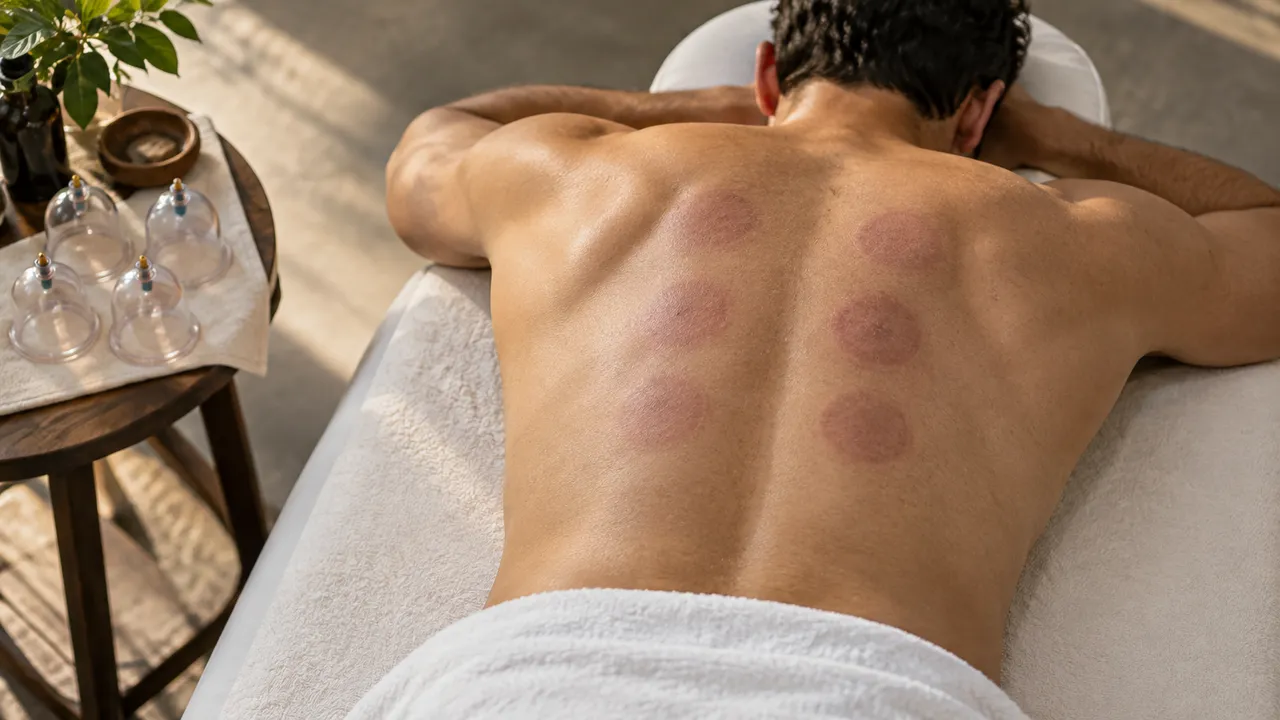
Cupping marks are a normal result of suction on skin, and they fade on their own. The main medical sources agree on what causes them and on roughly how long they stay. They also agree on a short list of signs that are not normal.
Why does cupping leave marks?
A cup creates a vacuum that pulls skin and the tissue under it upward. Cleveland Clinic (2023) explains that this suction force breaks open tiny blood vessels called capillaries under the skin, which leaves red, round marks. Harvard Health Publishing (2024) gives the same cause: the discoloration is due to broken blood vessels just beneath the skin.
The color comes from a small amount of blood that has leaked from those capillaries. None of these sources says the color shows that something harmful was drawn out of the body, and none links darker marks to better results. Marks also do not always appear. The American Massage Therapy Association (AMTA) says suction sometimes causes the circular marks, which means a session without marks is normal too.
Are cupping marks bruises?
They are close relatives. Harvard Health describes the discoloration as 'much like a bruise'. Cleveland Clinic draws a line: the marks look like bruises, but they are not true bruises that injure muscle fibers.
That matches how they feel. Cleveland Clinic says that after cupping you may feel bruised and slightly sore, but you should not have severe discomfort.
How long do cupping marks last?
| Source | What it says about the marks |
|---|---|
| Cleveland Clinic (2023) | Red, round marks that should fade in a week or two. |
| American Massage Therapy Association | Marks usually go away on their own after a week or two. |
| Harvard Health Publishing (2024) | Circular discolorations that fade over a number of days or weeks. |
| NCCIH, part of the NIH (2018) | Cupping leaves temporary marks on the skin. Possible side effects include persistent skin discoloration, scars, burns and infections. |
So a week or two is the usual range, and Harvard's wording leaves room for marks that clear within days. None of these sources gives a method that makes marks fade faster. If you have a beach day, a photo shoot or a physical exam coming up, plan cupping around it.
Who is more likely to bruise from cupping?
As a general rule, anything that makes you bleed or bruise more easily can make cupping marks more likely. The AMTA says cupping is not recommended for people with bleeding disorders or for anyone who regularly takes medicine like aspirin or ibuprofen, and calls for caution in people who use anticoagulants, have broken skin or are anemic. A 2014 article on massage and medication in the AMTA's Massage Therapy Journal, written about massage in general and not about cupping, quotes a Mayo Clinic physician saying blood thinners may make people more prone to bruising and internal bleeding. It also notes that corticosteroids can thin the skin and raise the tendency to bruise.
Cleveland Clinic advises people with anemia, bleeding disorders like hemophilia, or blood clotting problems such as deep vein thrombosis or a history of strokes to avoid cupping. Its list also names a pacemaker, cardiovascular disease, seizures (epilepsy) and skin conditions, including eczema and psoriasis.
If you take a blood thinner, daily aspirin, or steroids, or you have any condition on this list, talk to your doctor before you try cupping, and tell the therapist before the session. NCCIH adds that cupping may worsen eczema or psoriasis.
When should you see a doctor about cupping marks?
Cleveland Clinic calls cupping a relatively low-risk therapy, and Harvard Health says serious problems are quite unusual, though skin infections have rarely been reported. The table shows where normal ends. The reasons to call a healthcare provider are the ones Cleveland Clinic lists.
| What you notice | Normal? | What to do |
|---|---|---|
| Round red or dark marks without broken skin | Yes | Leave them alone. Expect fading within a week or two. |
| Feeling bruised and slightly sore | Yes | Nothing special. It should be mild. |
| Extreme pain or soreness | No | Call your healthcare provider. |
| Burns | No | Call your healthcare provider. |
| Fever, or redness, tenderness or yellow discharge at the site | No | Call your healthcare provider. These are signs of skin infection. |
| Fainting or feeling faint during cupping | Rare | Cleveland Clinic lists fainting as a rare reaction, most common after wet cupping. As a general precaution, tell the therapist right away and stop. |
Cleveland Clinic ties the burn risk to heated cups. According to the AMTA, many providers today use silicone or plastic cups, and some cups work with a hand or electric pump, with no flame involved.
Does cupping do anything besides leave marks?
The evidence is limited. In NCCIH's summary, cupping may help reduce pain, though the evidence is not very strong and most of the research is of low quality. Cupping does not remove fat. In a body sculpting session it is used as one of several massage techniques, and the marks are a side effect, not the goal.
Questions people ask
How long do cupping marks last?
Usually a week or two. That is Cleveland Clinic's figure, and Harvard Health says they fade over a number of days or weeks.
Do cupping marks hurt?
They can feel bruised and slightly sore. Cleveland Clinic says you should not have severe discomfort. Extreme pain is a reason to call a healthcare provider.
Is it bad if there are no marks after cupping?
No. The American Massage Therapy Association says suction sometimes causes circular marks, so having none is also normal.
Can you get cupping if you take blood thinners?
Talk to your doctor first. The AMTA calls for caution in people who use anticoagulants and does not recommend cupping for people with bleeding disorders or regular aspirin or ibuprofen use.
Do darker cupping marks mean it worked better?
No. The color comes from blood that leaked from broken capillaries under the skin, according to Cleveland Clinic and Harvard Health. None of the sources reviewed here links mark color to results.
Sources
This article is general information, not medical advice. Massage does not diagnose or treat any condition. If you have a health condition, ask your doctor whether massage is right for you.
 Your sessionDoes Massage Help Recovery After a Workout? The Evidence
Meta-analyses show massage after exercise reduces muscle soreness and fatigue. It does not improve strength, speed or endurance. Here is the data.
5 min read Your sessionFirst Body Sculpting Massage: What to Expect Step by Step
A first body sculpting massage step by step: health questions, lymphatic drainage, vibration, cupping, how each feels, and what is normal after.
5 min read Your sessionHow Long Does It Take to See Fat Loss Results?
Honest timelines: 1 to 2 pounds a week per the CDC, 2 to 3 months for fat freezing, months for liposuction swelling, and what massage can change.
5 min read