Does electrical muscle stimulation build abs? EMS compared with massage
Electrical muscle stimulation makes muscles contract, and the FDA says a device may temporarily strengthen, tone or firm a muscle. It will not produce a six-pack on its own, and no EMS device is cleared for weight loss or girth reduction. A clinic electromagnetic device showed thicker abdominal muscle in one small, uncontrolled study. Massage does not build muscle or remove fat.
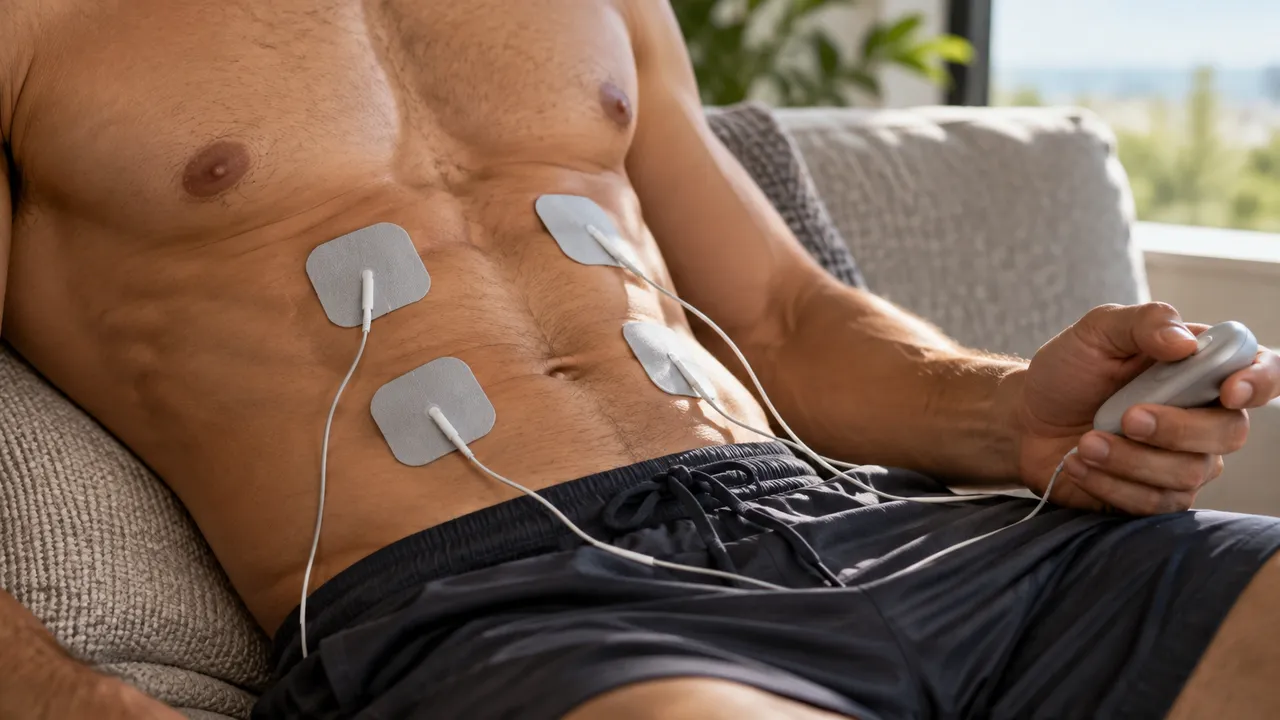
Electrical muscle stimulation, or EMS, sends a current through pads on the skin so the muscle underneath contracts without you doing the work. Ab belts use it at home. Clinics offer a stronger magnetic version. Both get compared with massage, which works in a different way. Here is what regulators and studies say about each.
What is electrical muscle stimulation?
The FDA regulates electrical muscle stimulators as medical devices. According to the agency's consumer page on EMS (last updated in 2017), most devices it has reviewed are meant for physical therapy and rehabilitation under the direction of a health care professional. Typical uses are muscle re-education, relaxing muscle spasms, increasing range of motion and preventing muscle atrophy. The FDA has also cleared an over-the-counter belt for toning, strengthening and firming abdominal muscles.
What does the FDA say about EMS and six-pack abs?
The FDA's wording is plain. No EMS devices have been cleared for weight loss, girth reduction or for obtaining 'rock hard' abs. Using these devices alone will not give you six-pack abs. Stimulating a muscle may temporarily strengthen, tone or firm it, but based on the data the agency had, it will not create a major change in your appearance without diet and regular exercise.
The agency also lists injuries reported with some of these devices: shocks, burns, bruising, skin irritation and pain, some of which needed hospital treatment. There have been reports of interference with implanted devices such as pacemakers and defibrillators.
What do studies of EMS belts show?
A sham-controlled trial published in the Journal of Strength and Conditioning Research in 2002 tested the advertising claims directly. Twenty-seven college-aged volunteers received either real EMS (16 people) or sham stimulation (11 people) three times a week, following the manufacturer's instructions. The stimulated muscles included the thighs, arms and abdominals. EMS had no significant effect on body weight, body fat, girth measurements, strength or appearance in photographs. The authors concluded that the claims for apparently healthy people were not supported.
This was one small study of one type of consumer device. It fits the FDA position that stimulation alone does not change how you look.
What is high-intensity electromagnetic stimulation?
Clinics offer high-intensity focused electromagnetic stimulation (HIFEM), sold as Emsculpt. The FDA's overview of non-invasive body contouring (updated October 2025) explains that pulsed magnetic fields trigger a small electric current in the muscles, which makes them contract. The stated aim is better muscle tone and firmness. The FDA adds that these effects may be temporary and may require ongoing procedures to maintain, and lists muscle soreness and cramps as side effects.
The best-known study appeared in Lasers in Surgery and Medicine in 2019. Twenty-two adults had four 30-minute abdominal sessions. MRI two months later showed the rectus abdominis muscle 15.4% thicker on average and the fat layer over it 18.6% thinner. Circumference measured below the navel was 3.8 cm (about 1.5 inches) smaller, and body weight did not change in a meaningful way.
The limits matter. The study had no control or sham group and was not randomized. One author was a medical advisor to the device maker. Only 4 patients were followed to six months. The authors themselves wrote that a larger controlled study is needed. So the evidence is early, and both the muscle and the fat findings need confirmation in controlled trials.
How does massage compare with EMS?
Massage is passive for the muscle. The therapist's hands or a device move the tissue, and the muscle does not contract against a load. That is why massage is not a way to build abs. It also does not remove fat. The National Center for Complementary and Integrative Health (2019) describes massage therapy as manipulating the soft tissues of the body and reports that the risk of harmful effects appears to be low. Its research summary finds short-term relief for neck and shoulder pain and only weak evidence for low-back pain.
The FDA overview lists mechanical massage and vibration devices among body contouring tools aimed at the appearance of cellulite, with temporary improvement. Body Sculpt sessions combine manual lymphatic drainage, G5 vibration massage and vacuum cupping.
| EMS belt at home | Electromagnetic stimulation in a clinic | Massage | |
|---|---|---|---|
| How it works | Electric current through skin pads | Pulsed magnetic field causes strong contractions | Hands or a device move soft tissue |
| Muscle | May temporarily tone or firm, per the FDA | Thicker muscle on MRI in one small uncontrolled study | No muscle building |
| Fat | No effect in a sham-controlled trial | Thinner fat layer reported, not yet confirmed in controlled trials | No fat removal |
| Regulator's view | Not cleared for weight loss, girth reduction or rock hard abs | Effects may be temporary and need upkeep | Massage devices: temporary change in appearance |
| Known risks | Shocks, burns, skin irritation, device interference | Muscle soreness and cramps | Soreness or bruising |
What actually makes abs visible?
Two things, and neither is a gadget. The abdominal muscles have to be trained, and the fat layer over them has to be thin enough to show them. The FDA puts it simply: no major change in appearance without diet and regular exercise. Strength training builds the muscle. A calorie deficit kept up over time lowers body fat. EMS, magnetic stimulation and massage can sit next to that work, but none of them replaces it.
Questions people ask
Can an ab belt give me a six-pack?
Not by itself. The FDA states that using EMS devices alone will not give you six-pack abs and that no EMS device is cleared for obtaining rock hard abs. A 2002 sham-controlled trial found no change in strength, girth or appearance.
Does EMS reduce belly fat?
There is no good evidence that it does. No EMS device is cleared by the FDA for weight loss or girth reduction, and the 2002 trial found no effect on body fat. Body fat goes down with a calorie deficit.
Is clinic electromagnetic muscle stimulation backed by strong evidence?
Not yet. A 2019 MRI study of 22 adults reported 15.4% thicker abdominal muscle and an 18.6% thinner fat layer two months after four sessions, but it had no control group and one author advised the manufacturer. Larger controlled studies are needed.
Is EMS safe?
The FDA has received reports of shocks, burns, bruising, skin irritation and pain with some EMS devices, and of interference with pacemakers and defibrillators. Check with your doctor if you have an implant or a heart condition.
Does massage tone muscles?
No. During massage the muscle is moved, it does not work against resistance, so there is no training effect. Massage may give short-term relief of neck and shoulder pain, and it does not remove fat.
Sources
- FDA: Electronic Muscle Stimulators (2017)
- FDA: Non-Invasive Body Contouring Technologies (2025)
- Porcari et al., Effects of electrical muscle stimulation on body composition, muscle strength, and physical appearance, Journal of Strength and Conditioning Research (2002)
- Kinney and Lozanova, High intensity focused electromagnetic therapy evaluated by magnetic resonance imaging, Lasers in Surgery and Medicine (2019)
- NCCIH: Massage Therapy: What You Need To Know (2019)
This article is general information, not medical advice. Massage does not diagnose or treat any condition. If you have a health condition, ask your doctor whether massage is right for you.
 ComparedBody Sculpting Massage or Cryolipolysis: What Each One Does
Cryolipolysis thins a pinchable fat layer over 2 to 3 months and has rare but real risks. Massage does not reduce fat. Here is what each one does.
5 min read ComparedCompression Boots or Manual Lymphatic Drainage: Which Is Better?
Pneumatic compression boots and manual lymphatic drainage both move fluid. What trials show for lymphedema and for recovery after training, and the limits.
5 min read ComparedMassage or Liposuction: What Is the Difference?
Liposuction is surgery that removes fat cells and needs weeks of recovery. Massage removes no fat. What each does, the risks, and massage after surgery.
5 min read