Neither is clearly better. For lymphedema, pneumatic compression and manual lymphatic drainage are both add-ons to compression garments, and trials show small or inconsistent extra benefit from either. For athletes, compression boots mainly reduce perceived soreness, with trivial to small effects on muscle function. In healthy men, neither removes fat. Choose by goal, comfort and medical advice.
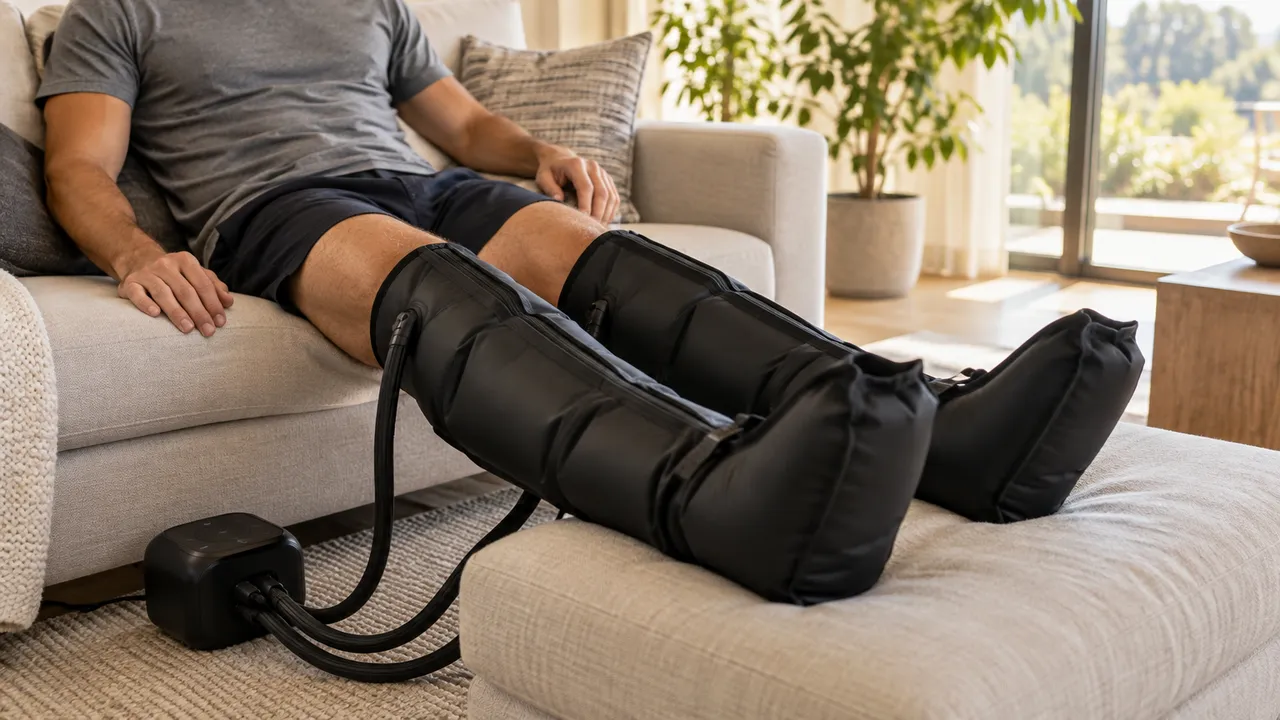
Compression boots and manual lymphatic drainage are built on the same idea: gentle pressure applied in a sequence helps fluid move out of a limb. One uses an air pump and sleeves. The other uses a therapist's hands. Most of the research on both comes from lymphedema care and, for boots, from sports recovery. Very little of it was done in healthy men who want to look leaner, and that gap shapes the honest answer.
What are compression boots (pressotherapy)?
The medical name is intermittent pneumatic compression, or IPC. Cleveland Clinic (2023) describes IPC devices as inflatable sleeves connected to a machine that inflates and deflates them every 20 to 60 seconds, and says the sensation feels like a leg massage. Squeezing helps blood move back toward the heart. Hospitals use the sleeves mainly to prevent blood clots in the legs of people who are not moving much after illness or surgery. Cleveland Clinic notes the devices can also treat lymphedema.
Recovery boots sold to athletes and pressotherapy offered in spas use the same principle: air chambers around the leg inflate and deflate in cycles.
What is manual lymphatic drainage?
Manual lymphatic drainage (MLD) is a light-pressure technique done by hand. Cleveland Clinic (2024) explains that the therapist usually starts at lymph node areas such as the neck and armpits, then moves excess fluid from swollen tissue toward working lymph vessels and nodes. Providers mainly use it to relieve lymphedema after breast cancer surgery. The clinic says it should not be the only treatment for lymphedema, and that people without lymphedema may not see meaningful results.
What does research show for lymphedema?
The strongest data are in women with arm swelling after breast cancer treatment, so they do not transfer directly to healthy men. They still show how the two methods compare.
- A 2015 Cochrane review of 6 trials found MLD safe and concluded it may offer additional benefit to compression bandaging. Bandaging alone reduced excess volume by 30% to 38.6%. Adding MLD brought a further 7.11 percentage points in two trials with 83 participants.
- In the same review, one trial of 24 people compared a compression sleeve plus MLD with a sleeve plus a pneumatic pump. Volume reduction favored MLD by 47 mL. The percentage reduction was only borderline, and the reviewers called the results inconsistent.
- A 2024 systematic review in Breast Care pooled 9 randomized trials. Adding a pneumatic compression pump to standard decongestive therapy did not significantly change swelling volume, pain or heaviness compared with decongestive therapy alone. One measure of shoulder mobility was somewhat better with the pump.
The pattern is consistent. Compression garments and bandaging do most of the work. MLD and pumps are add-ons, and the extra effect of either is small. The Cochrane reviewers also noted that the trials were small, from 24 to 45 participants each.
Do compression boots help recovery after training?
A 2024 systematic review in Biology of Sport pooled 17 studies with 319 athletic and healthy participants. Lower-limb pneumatic compression showed a trivial to small benefit for muscle function, a trivial to moderate effect on pain and soreness, and highly variable effects on blood markers of muscle damage. The authors wrote that the method still lacks strong scientific support and that its main potential effect is reducing perceived soreness. The most common protocols lasted about 20 to 30 minutes at pressures of about 80 mmHg.
For manual lymphatic drainage in healthy, trained people, the sources reviewed here offer less. Cleveland Clinic lists reduced fluid retention among possible benefits, with cautious wording.
How do the two differ in practice?
| Compression boots (IPC) | Manual lymphatic drainage | |
|---|---|---|
| Pressure comes from | Air chambers filled by a pump | A trained therapist's hands |
| Pattern | Fixed cycles, the same every time | Adjusted by feel to the person and the area |
| Areas | Mostly legs, some devices for arms | Any area, including abdomen, trunk and neck |
| Medical use | Preventing leg blood clots, add-on for lymphedema | Add-on for lymphedema |
| Evidence in healthy people | Small effect on soreness after exercise | Limited |
| Effect on fat | None | None |
Boots are easy to repeat and need no therapist. Hands can reach the abdomen and flanks, where boots do not go, and a therapist can change pressure and direction as the tissue responds. A Body Sculpt session begins with manual lymphatic drainage, followed by G5 vibration massage, with vacuum cupping added from the second or third session.
Who should check with a doctor first?
Which is better for body sculpting goals?
Neither reduces body fat. Fat goes down with a calorie deficit, and no trial cited here shows that boots or lymphatic drainage change that. What both can do is move fluid for a while, which may make the treated area feel lighter and look less puffy for a short time.
- Sore legs after hard trainingBoots have the most data here, and the benefit is mostly in how sore you feel.
- Abdomen, flanks or a full-body sessionManual work reaches areas that boots cannot.
- Diagnosed lymphedemaFollow your lymphedema therapist or doctor. Compression garments come first, and MLD or a pump is added as prescribed.
- Fat lossNeither. Put the effort into eating, activity and sleep.
Questions people ask
Are compression boots the same as lymphatic drainage massage?
No. Both apply sequential pressure to move fluid, but boots use air chambers with fixed cycles on the legs or arms, and manual lymphatic drainage is light hand pressure that a therapist adapts to each area, including the trunk.
Do compression boots help with recovery?
A little. A 2024 systematic review of 17 studies found trivial to small benefits for muscle function and a trivial to moderate effect on soreness. The authors said the method still lacks strong scientific support.
Is manual lymphatic drainage better than a pump for lymphedema?
Evidence does not show a clear winner. One small trial in a 2015 Cochrane review favored MLD over a pump for volume reduction, while a 2024 review of 9 trials found that adding a pump to standard therapy made no significant difference. Compression garments remain the base of treatment.
Do compression boots or lymphatic drainage reduce fat?
No. Neither method removes fat or lowers body weight. Any visible change comes from fluid moving out of the tissue, and it is temporary.
Who should avoid these methods?
People with blood clots, deep vein thrombosis, infection, fever, heart disease, kidney failure or stroke should not have lymphatic drainage massage, according to Cleveland Clinic. New, one-sided or painful swelling should be checked by a doctor before any compression.
Sources
- Cleveland Clinic: Intermittent Pneumatic Compression Devices (2023)
- Cleveland Clinic: Lymphatic Drainage Massage (2024)
- Ezzo et al., Manual lymphatic drainage for lymphedema following breast cancer treatment, Cochrane Database of Systematic Reviews (2015)
- Yao et al., Intermittent pneumatic compression pump as adjunct to decongestive lymphatic therapy for upper limb lymphedema after breast cancer surgery (systematic review and meta-analysis), Breast Care (2024)
- Maia et al., Effects of lower-limb intermittent pneumatic compression on sports recovery: a systematic review and meta-analysis, Biology of Sport (2024)
This article is general information, not medical advice. Massage does not diagnose or treat any condition. If you have a health condition, ask your doctor whether massage is right for you.
 ComparedBody Sculpting Massage or Cryolipolysis: What Each One Does
Cryolipolysis thins a pinchable fat layer over 2 to 3 months and has rare but real risks. Massage does not reduce fat. Here is what each one does.
5 min read ComparedDoes EMS Build Abs? Muscle Stimulation vs. Massage
The FDA says EMS alone will not give you six-pack abs. What ab belts and clinic electromagnetic devices do in studies, and how massage differs.
5 min read ComparedMassage or Liposuction: What Is the Difference?
Liposuction is surgery that removes fat cells and needs weeks of recovery. Massage removes no fat. What each does, the risks, and massage after surgery.
5 min read