Myofascial release and foam rolling apply slow pressure to muscle and the connective tissue around it. Reviews show a short-term increase in range of motion, about as much as stretching gives, and a small reduction in muscle pain after exercise. Effects on performance are minor. The effect is more likely explained by the nervous system than by physically releasing fascia.
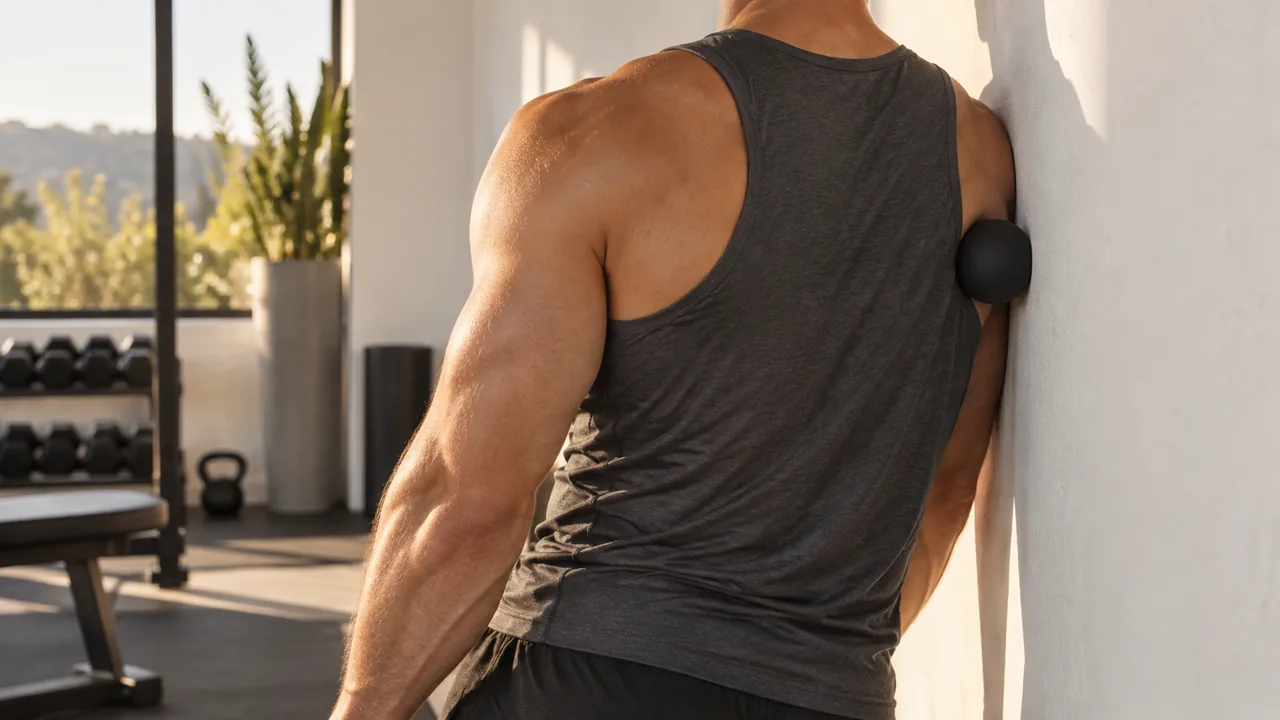
Myofascial release is a manual therapy technique, and foam rolling is the do-it-yourself version. Both press slowly on tight areas with the aim of making tissue move more freely and feel less sore. Foam rolling in particular has been studied enough to say what it does, how big the effect is and how long it lasts.
What are myofascial release and foam rolling?
Fascia is the connective tissue that covers and supports the muscles. Cleveland Clinic compares it to a spider web woven through muscles, bones, nerves, blood vessels and organs. In myofascial release therapy a provider finds areas that feel stiff and tight and applies gentle, constant pressure, slowly, without oils or lotions, in an attempt to lengthen the tissue. Sessions last 15 to 50 minutes. Cleveland Clinic says it may help anyone who has tightness in their fascial tissues. Most of the research summarized below was done on foam rolling.
Foam rolling is classed as self-myofascial release. You lie or lean on a foam tube and use your body weight to press on the muscle while you roll slowly along it. Roller sticks and massage balls work on the same idea.
What does foam rolling do for mobility?
This is the best-supported effect. A 2020 systematic review with meta-analysis in Sports Medicine pooled 26 trials in healthy adults. Compared with doing nothing, foam rolling had a large positive effect on range of motion right after the session. It was not better than stretching: the two were about equal. Rollers with built-in vibration did not show a significant extra benefit in the pooled results, and the analysis suggested rolling may be somewhat less effective in men.
A 2019 meta-analysis of 21 studies in Frontiers in Physiology put a number on it: rolling before exercise improved flexibility by about 4%. The gain is short term. Neither review shows a lasting change in tissue length from a single session.
Does foam rolling reduce soreness and improve performance?
| Outcome | What the 2019 meta-analysis found | Size of effect |
|---|---|---|
| Flexibility, rolling before exercise | Improved by about 4% | Small |
| Sprint, rolling before exercise | Improved by about 0.7% | Small |
| Jump and strength, rolling before exercise | Jump about 1.9% lower, strength about 1.8% higher | Negligible |
| Muscle pain, rolling after exercise | Pain perception reduced by about 6% | Small to moderate |
| Sprint and strength, rolling after exercise | Losses after hard exercise were about 3% to 4% smaller | Small |
The authors' own summary is restrained: the effects of foam rolling on performance and recovery are rather minor and partly negligible, but can be relevant in some cases, such as raising flexibility or reducing the sensation of muscle pain. They concluded that the evidence supports foam rolling more as a warm-up activity than as a recovery tool.
Cleveland Clinic is similarly careful about delayed soreness, the kind that starts a day or two after a workout. Rolling after exercise may help with acute pain relief, but research is thin on whether it can prevent delayed soreness.
Does rolling really release fascia?
Probably not in the way the name suggests. A 2019 narrative review in Sports Medicine examined how rolling works and concluded that there is insufficient evidence that the primary mechanism is the release of myofascial restrictions. The authors called the term self-myofascial release misleading.
The explanations they consider more likely involve the nervous system. Pressure activates sensors in the skin and fascia, which can lower muscle tone by reflex and engage the body's own pain-dampening systems. Short-term changes in blood flow and in how fluid the tissue is may also play a part. In practice, this means rolling changes how a muscle feels and how far you are willing to stretch it for a while. There is no good evidence that it remodels the tissue.
The same logic applies to appearance. Cleveland Clinic states there is no real evidence that foam rolling improves the look of cellulite, and rolling does not reduce body fat.
How do you foam roll correctly?
These steps follow Cleveland Clinic's guidance.
- Start lightUse a smooth, lightweight roller and do not put your whole body weight into it right away. Find your tolerance first.
- Roll slowlyMove slowly along the muscle and breathe deeply.
- Work around tender spotsIf you hit a tender spot, ease the pressure and work the area around it before returning to it.
- Keep it shortSpend about one to two minutes per muscle group or area that feels sore or stiff.
- Stay off the jointsBe careful around ankles, knees and elbows. Rolling there can push the joint past its normal range.
- Adjust the next dayIf you are sore from rolling the next day, use less pressure next time.
Who should be careful with myofascial release?
Cleveland Clinic says myofascial release therapy, like other massage methods, does not have many risks. Rare complications include internal bleeding, trouble moving muscles, short-term paralysis and nerve damage. For foam rolling, it advises speaking with your doctor first if you have a broken bone or a torn muscle.
Questions people ask
Does foam rolling actually work?
For short-term flexibility, yes. A 2020 meta-analysis of 26 trials found a large positive effect on range of motion compared with doing nothing, about equal to stretching. Effects on performance and recovery are small.
Is foam rolling better than stretching?
No. In the 2020 meta-analysis, foam rolling was not superior to stretching for range of motion. The two gave similar short-term gains, so you can use whichever you prefer.
Should I foam roll before or after a workout?
Both are reasonable, but the evidence is stronger for before. A 2019 meta-analysis concluded that the evidence supports foam rolling as a warm-up activity more than as a recovery tool. Rolling after exercise reduced muscle pain perception by about 6%.
Does foam rolling get rid of cellulite or fat?
No. Cleveland Clinic states there is no real evidence that foam rolling improves the appearance of cellulite. Rolling does not reduce body fat.
How long should I foam roll each muscle?
Cleveland Clinic suggests about one to two minutes per muscle group or area that feels sore or stiff, starting with light pressure.
What is the difference between myofascial release and foam rolling?
Myofascial release therapy is done by a provider, who applies gentle, constant pressure to tight areas by hand. Foam rolling is self-myofascial release: you apply the pressure yourself with a foam tube.
Sources
- Wiewelhove T et al. A Meta-Analysis of the Effects of Foam Rolling on Performance and Recovery. Frontiers in Physiology, 2019
- Wilke J et al. Acute Effects of Foam Rolling on Range of Motion in Healthy Adults: A Systematic Review with Multilevel Meta-analysis. Sports Medicine, 2020
- Behm DG, Wilke J. Do Self-Myofascial Release Devices Release Myofascia? Rolling Mechanisms: A Narrative Review. Sports Medicine, 2019
- Cleveland Clinic: Myofascial Release Therapy (updated 2022)
- Cleveland Clinic: Should You Try Foam Rolling? (2023)
This article is general information, not medical advice. Massage does not diagnose or treat any condition. If you have a health condition, ask your doctor whether massage is right for you.
 TechniquesDeep Tissue vs Sports vs Swedish Massage: The Difference
Swedish massage is gentle and full-body, deep tissue works tight muscles with firm pressure, sports massage targets the muscles you train. How to choose.
5 min read TechniquesDoes Massage Burn Fat? What the Research Actually Says
No. Massage does not burn fat. A plain review of the studies on massage, circumference, cellulite and fat thickness, and how strong they are.
6 min read TechniquesDoes Wood Therapy (Maderotherapy) Work? The Evidence
Wood therapy is massage with wooden rollers and cups, sold for fat and cellulite. No clinical studies of it appear in PubMed. What related research shows.
5 min read