Sports massage is hands-on work on the muscles and soft tissue used in training, done before an event, after it or between sessions. A 2020 meta-analysis of 29 studies found small improvements in flexibility and in soreness after exercise, but no improvement in strength, jump, sprint or endurance. It supports recovery and comfort. It does not directly raise performance.
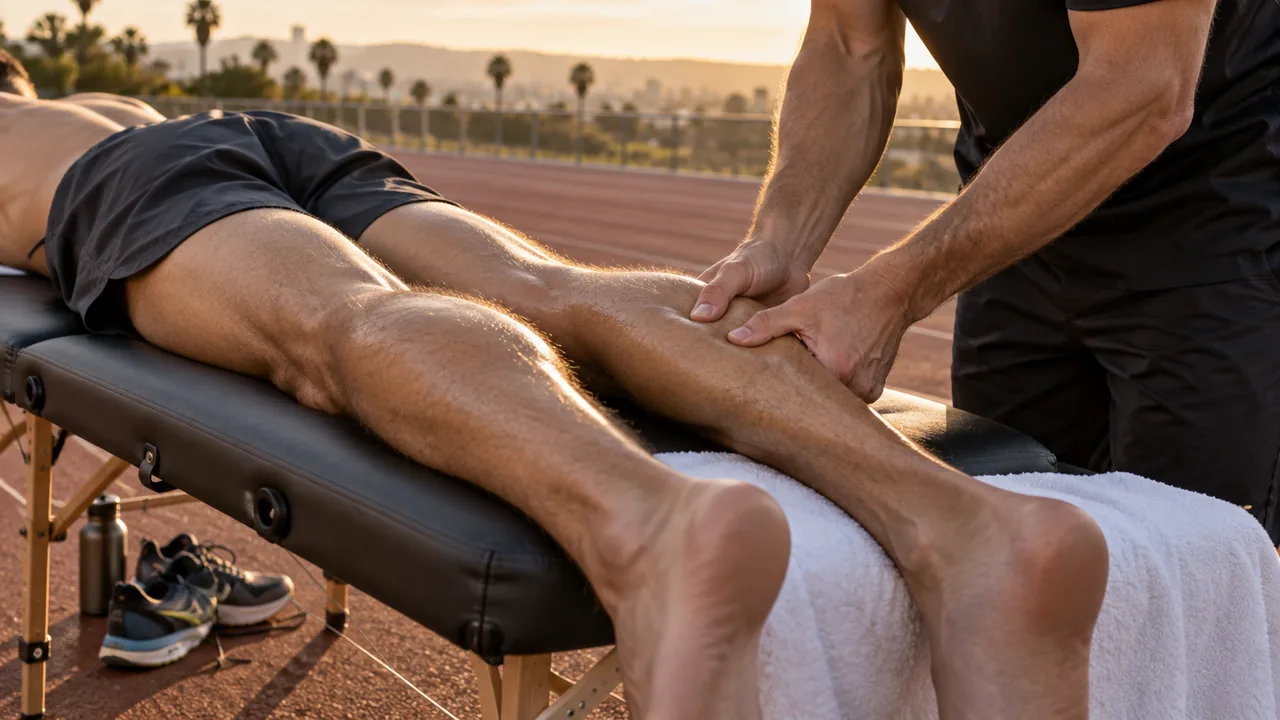
Sports massage is massage planned around training. The therapist works on the muscles your sport or gym routine loads the most, and the timing and pressure change with the goal: warming up, recovering or keeping tissue comfortable through a training block. It is one of the better-studied forms of massage, and the research is clear about where it helps and where it does not.
What is sports massage?
There is no single official definition. The authors of a 2020 systematic review in BMJ Open Sport and Exercise Medicine defined it as manual manipulation of muscles and soft tissue by a qualified professional, with the purpose of improving performance in or recovery from sport. The National Center for Complementary and Integrative Health (NCCIH) lists sports massage as one of the styles of massage therapy alongside Swedish or classical massage.
The strokes themselves are familiar. The American Massage Therapy Association (AMTA) names three techniques, all part of Swedish massage, as the starting place.
- Effleurage: long, slow strokes that warm up the muscles before deeper work.
- Petrissage: slow, rhythmic kneading of muscles and fascia.
- Tapotement: rapid, rhythmic, percussion-like hand movements.
What makes it sports massage is the plan. AMTA notes that techniques and strategies vary depending on the athlete's sport, and that there is no one formula for every athlete.
When is sports massage done?
- Before an eventAMTA defines pre-event as anywhere from 15 minutes to two or three hours before the start. The focus is on warm-up and on helping the athlete relax. Heavy deep tissue work is avoided at this point.
- After an event or hard sessionPost-event massage is aimed at recovery. This is where the research on muscle soreness applies.
- During the training seasonAMTA describes a growing role for regular massage through the training season, with the therapist following the athlete's program over weeks and months.
What do reviews show about recovery, flexibility and pain?
| Outcome | What reviews found | How solid it is |
|---|---|---|
| Soreness after exercise | A 2020 meta-analysis (10 studies, 311 participants) found a 13% improvement in soreness. A 2017 meta-analysis of 11 articles on randomized trials (504 participants) found lower soreness at 24, 48 and 72 hours compared with no treatment | Consistent direction. Soreness is rated by the person, so placebo effects are possible |
| Flexibility | The 2020 meta-analysis (7 studies, 246 participants) found a 7% increase in flexibility scores | Small effect, very uneven results between studies |
| Feeling of fatigue | A 2018 meta-analysis of 99 studies of recovery methods found massage to be the most effective method for reducing soreness and perceived fatigue | Based on how tired people felt, not on output |
| Markers of muscle damage | The 2017 meta-analysis found lower levels of creatine kinase, a blood marker of muscle damage, after massage. In the 2018 analysis, massage and cold exposure were the most effective methods for lowering markers of inflammation | Pooled data from small trials |
The 2018 analysis compared massage with other recovery methods, including compression garments, water immersion, cold exposure and active recovery. Massage came out on top for soreness and perceived fatigue. The authors of the 2020 review add a practical reading: sports that are more likely to cause soreness have more to gain from massage, especially when you have to perform again before the soreness has passed, as in multi-day events.
What does sports massage not do for performance?
The largest review to date is the 2020 meta-analysis, which covered 29 randomized studies and 1,012 participants. It found no evidence that massage improves strength, jump, sprint, endurance or measured muscle fatigue. One trial in that review even found lower peak thigh muscle force right after a 20-minute pre-event massage, which is one reason pre-event work is kept light.
The evidence is not perfectly uniform. The 2017 meta-analysis reported better recovery of muscle force after strenuous exercise in people who received massage. The 2020 authors point out the limits of the whole field: small studies, very different massage protocols, sessions ranging from brief bouts to 40 minutes, and uncertainty about the best duration and timing.
- It does not make you stronger, faster or more enduring on its own.
- It does not replace training, sleep or food.
- It does not burn fat. Body fat changes with calorie balance, not with massage.
Is sports massage safe, and who should be careful?
For most people massage is low risk, according to NCCIH. It notes rare reports of serious harm, including blood clots, nerve injury and bone fracture, some of them tied to vigorous types of massage or to people who were already at higher risk of injury.
Questions people ask
Does sports massage improve athletic performance?
Not directly. A 2020 meta-analysis of 29 randomized studies with 1,012 participants found no evidence that massage improves strength, jump, sprint or endurance. It found small improvements in flexibility and in soreness after exercise.
Does sports massage help with muscle soreness?
Yes, modestly. Three pooled reviews, from 2017, 2018 and 2020, all found less soreness after exercise in people who received massage. The 2020 analysis put the improvement at 13%.
When is the best time to get a sports massage?
Before an event the work is light and aimed at warm-up, within 15 minutes to two or three hours of the start, according to AMTA. For soreness, massage is given after hard exercise. Researchers say the best timing and duration are still uncertain.
How long should a sports massage last?
There is no proven best length. Studies in the 2020 review used sessions from brief bouts up to 40 minutes, and the authors noted uncertainty about the optimal duration.
Does sports massage burn fat or build muscle?
No. Massage does not burn fat and does not build muscle. Its measured benefits are less soreness, slightly better flexibility and feeling less fatigued.
Sources
- Davis HL et al. Effect of sports massage on performance and recovery: a systematic review and meta-analysis. BMJ Open Sport and Exercise Medicine, 2020
- Dupuy O et al. An Evidence-Based Approach for Choosing Post-exercise Recovery Techniques: A Systematic Review With Meta-Analysis. Frontiers in Physiology, 2018
- Guo J et al. Massage Alleviates Delayed Onset Muscle Soreness after Strenuous Exercise: A Systematic Review and Meta-Analysis. Frontiers in Physiology, 2017
- American Massage Therapy Association: Massage Therapy for Athletes (Massage Therapy Journal, 2020)
- NCCIH (NIH): Massage Therapy: What You Need To Know
This article is general information, not medical advice. Massage does not diagnose or treat any condition. If you have a health condition, ask your doctor whether massage is right for you.
 TechniquesDeep Tissue vs Sports vs Swedish Massage: The Difference
Swedish massage is gentle and full-body, deep tissue works tight muscles with firm pressure, sports massage targets the muscles you train. How to choose.
5 min read TechniquesDoes Massage Burn Fat? What the Research Actually Says
No. Massage does not burn fat. A plain review of the studies on massage, circumference, cellulite and fat thickness, and how strong they are.
6 min read TechniquesDoes Wood Therapy (Maderotherapy) Work? The Evidence
Wood therapy is massage with wooden rollers and cups, sold for fat and cellulite. No clinical studies of it appear in PubMed. What related research shows.
5 min read