Warmth in a massage comes from friction and kneading, from heated tools such as hot stones, or from warming creams. Rubbing raises skin temperature and skin blood flow but barely changes deep muscle. Applied heat can raise muscle temperature and blood flow and ease soreness for a while. Warming does not burn fat, and heat carries a real risk of burns.
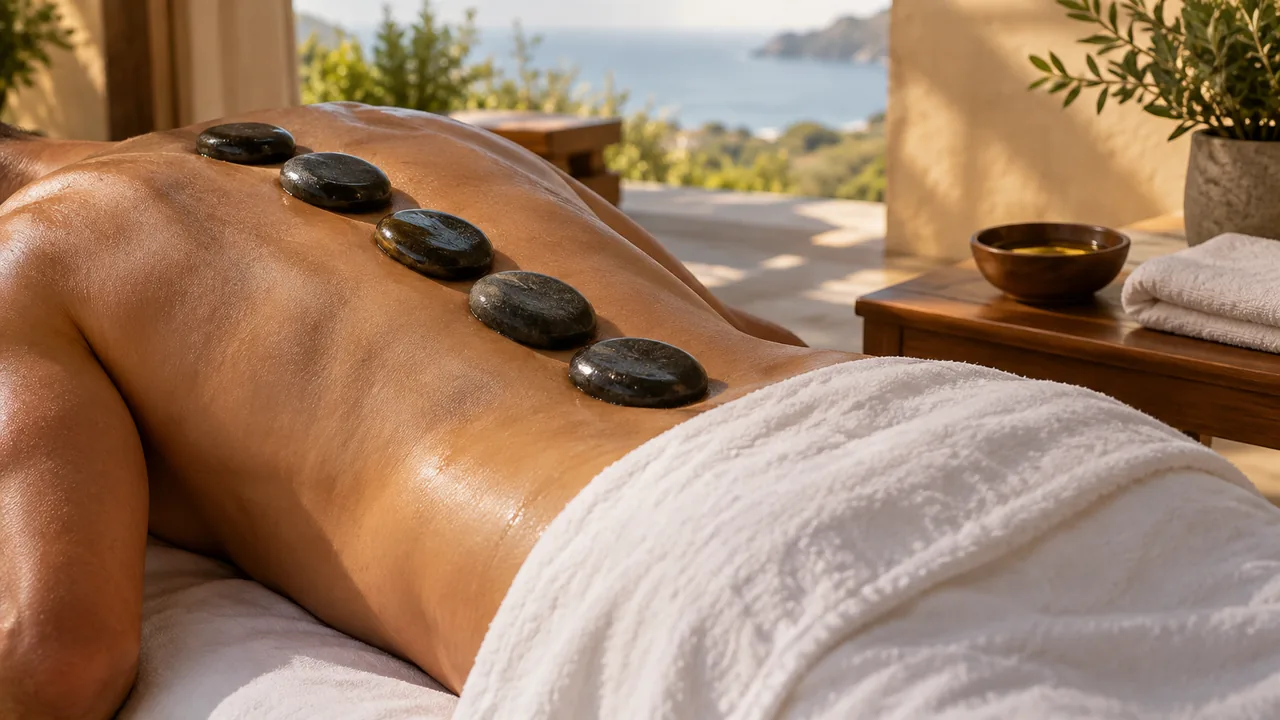
A warm, flushed feeling is one of the first things people notice in a massage. It comes from several sources that work differently and go to different depths. Knowing which is which helps you judge claims about circulation, recovery and fat, and helps you avoid the one real hazard of heat, which is a burn.
Where does the warmth in a massage come from?
| Source of warmth | What it warms | What is known | Main risk |
|---|---|---|---|
| Hands: friction and kneading | Mostly the skin | In a 2004 study, massage raised skin temperature and skin blood flow but not muscle temperature | Low |
| Hot stones | The skin and tissue under the stone | Stones are heated in water at 110 to 130 °F (43 to 54 °C), according to the American Massage Therapy Association (AMTA) | Burns |
| Heat packs, wraps, warm water | Skin and, with enough time, muscle | In a study cited in a 2026 review, 46 °C (115 °F) water circulated through a garment for 30 minutes raised calf muscle temperature by 3.7 °C (6.7 °F) | Burns, overheating |
| Warming creams with capsaicin | Nerve endings in the skin | Capsaicin works by affecting nerve cells in the skin associated with pain, according to MedlinePlus | Skin irritation, blistering |
How much does massage itself warm the tissue?
Less than it feels. A 2004 study in Medicine and Science in Sports and Exercise tested 13 men after leg exercise. They received two 6-minute bouts of deep stroking and kneading of the thigh or simply rested. After massage, skin temperature was 32.2 °C against 31.1 °C at rest (about 90 °F against 88 °F), and skin blood flow was much higher. Blood flow in the main artery of the thigh did not rise, and neither did muscle temperature.
So the warmth from hands is real, but it sits in the skin. The authors suggested that, with no rise in arterial flow, the extra skin blood flow may even be diverted away from the recovering muscle, which would call massage as a recovery aid into question. The pleasant glow after a massage is a skin response, not proof of a deep change in the muscle.
What does applied heat do to blood flow and muscles?
External heat goes deeper than friction if it is applied long enough. A 2026 review of heat therapy in Comprehensive Physiology gives the reference points: resting muscle temperature is about 34.5 to 36.5 °C (94 to 98 °F), and some studies report muscle blood flow rising 1.5 to 4 times after local or whole-body heating. The same review notes that few studies have measured this thoroughly and that some found no effect of heating on muscle blood flow.
- Soreness after exercise: the 2026 review reports general agreement that heat applied after muscle-damaging exercise reduces delayed soreness and, to a lesser extent, the loss of strength.
- Low-back pain: a 2006 Cochrane review of 9 trials with 1,117 participants found moderate evidence, from a small number of trials, that heat wrap therapy gives a small short-term reduction in pain and disability in acute and sub-acute low-back pain. The authors called the overall evidence base limited.
- Hot stones: AMTA describes how to use them safely, but none of the sources reviewed here includes a controlled trial showing that stones add benefit beyond massage and warmth.
In short, heat is a reasonable comfort and recovery aid with modest evidence. It is not a treatment that changes body composition.
Does warming the body burn fat?
No. Warm skin, redness and sweat are signs of blood flow and fluid loss, not of fat loss. In a study described in the 2026 review, people lost some body mass during a 45-minute far-infrared sauna session, and they lost it through sweating. Sweat is water, and that weight returns when you drink. Body fat goes down with a calorie deficit, and a hot tool or warming cream does not create one.
How is heat used safely in a massage?
- Stones are heated in water, in a proper heaterAMTA says the only safe way to heat stones is in water in a professional stone heater, because water temperature can be controlled. Microwaves, hot plates, slow cookers and ovens are never appropriate.
- The therapist tests the heat firstAMTA's rule: if the stones are too hot for the therapist to hold, they are too hot for the client.
- A barrier goes under placed stonesA sheet, towel or clothing should sit between bare skin and a stone that is left in place.
- You speak up earlyAccording to AMTA, heat from a placed stone takes about 3 to 4 minutes on average to come through fully. Say so the moment it feels too hot. Do not wait for it to pass.
- No heat over warming creamsMedlinePlus advises protecting skin treated with capsaicin from direct heat such as heating pads, electric blankets and heat lamps, and not wrapping or bandaging the area.
Who should avoid heat in massage?
The 2026 review lists the general risks of heat therapy: overheating, dehydration, low blood pressure and burns on hot surfaces. It adds that people with diabetes, peripheral neuropathy or spinal cord injury may be at extra risk of skin burns because they may feel temperature and pain less. AMTA's list of contraindications for hot and cold stone massage, which it says is not exhaustive, includes the following.
- Diabetes
- Neuropathy
- Heart disease
- Skin conditions
- Recent surgeries
- Cancer
- Autoimmune conditions
- Epilepsy
Questions people ask
Does heat or a warming massage burn fat?
No. Heat raises skin blood flow and can make you sweat, and sweat is water. Body fat goes down only with a calorie deficit. No source reviewed here shows that warming the skin removes fat.
Why does my skin get red and warm during a massage?
Friction and kneading raise skin blood flow and skin temperature. In a 2004 study, skin temperature after massage was about 1 °C (2 °F) higher than at rest, while muscle temperature and blood flow in the main thigh artery did not change.
Is hot stone massage safe?
It can be when the stones are heated in water in a professional heater, tested by the therapist and separated from bare skin by a sheet or towel when left in place. The main risk is burns. AMTA lists diabetes, neuropathy, heart disease, skin conditions and recent surgery among the contraindications.
Can I use a warming cream together with a heating pad?
No. MedlinePlus advises protecting skin treated with capsaicin from direct heat such as heating pads, electric blankets, hair dryers and heat lamps. Do not wrap or bandage the area either.
Does heat help sore muscles after a workout?
It may. A 2026 review of heat therapy reports general agreement that heat applied after muscle-damaging exercise reduces delayed soreness and, to a lesser extent, the loss of strength.
Sources
- Hinds T et al. Effects of massage on limb and skin blood flow after quadriceps exercise. Medicine and Science in Sports and Exercise, 2004
- Richey RE et al. Heat Therapy: Targeting Health, Disease, and Disability. Comprehensive Physiology, 2026
- French SD et al. Superficial heat or cold for low back pain. Cochrane Database of Systematic Reviews, 2006
- American Massage Therapy Association: (Don't) Feel the Burn: Hot Stone Massage (Massage Therapy Journal, 2010)
- MedlinePlus (NIH): Capsaicin Topical
This article is general information, not medical advice. Massage does not diagnose or treat any condition. If you have a health condition, ask your doctor whether massage is right for you.
 TechniquesDeep Tissue vs Sports vs Swedish Massage: The Difference
Swedish massage is gentle and full-body, deep tissue works tight muscles with firm pressure, sports massage targets the muscles you train. How to choose.
5 min read TechniquesDoes Massage Burn Fat? What the Research Actually Says
No. Massage does not burn fat. A plain review of the studies on massage, circumference, cellulite and fat thickness, and how strong they are.
6 min read TechniquesDoes Wood Therapy (Maderotherapy) Work? The Evidence
Wood therapy is massage with wooden rollers and cups, sold for fat and cellulite. No clinical studies of it appear in PubMed. What related research shows.
5 min read