Alcohol does not turn straight into belly fat, but it makes fat gain easier. A standard drink carries about 100 to 150 calories, the body sharply cuts fat burning while it clears alcohol, and people rarely eat less to compensate. In studies, heavy drinking is linked to more abdominal fat in men. Light drinking mostly is not.
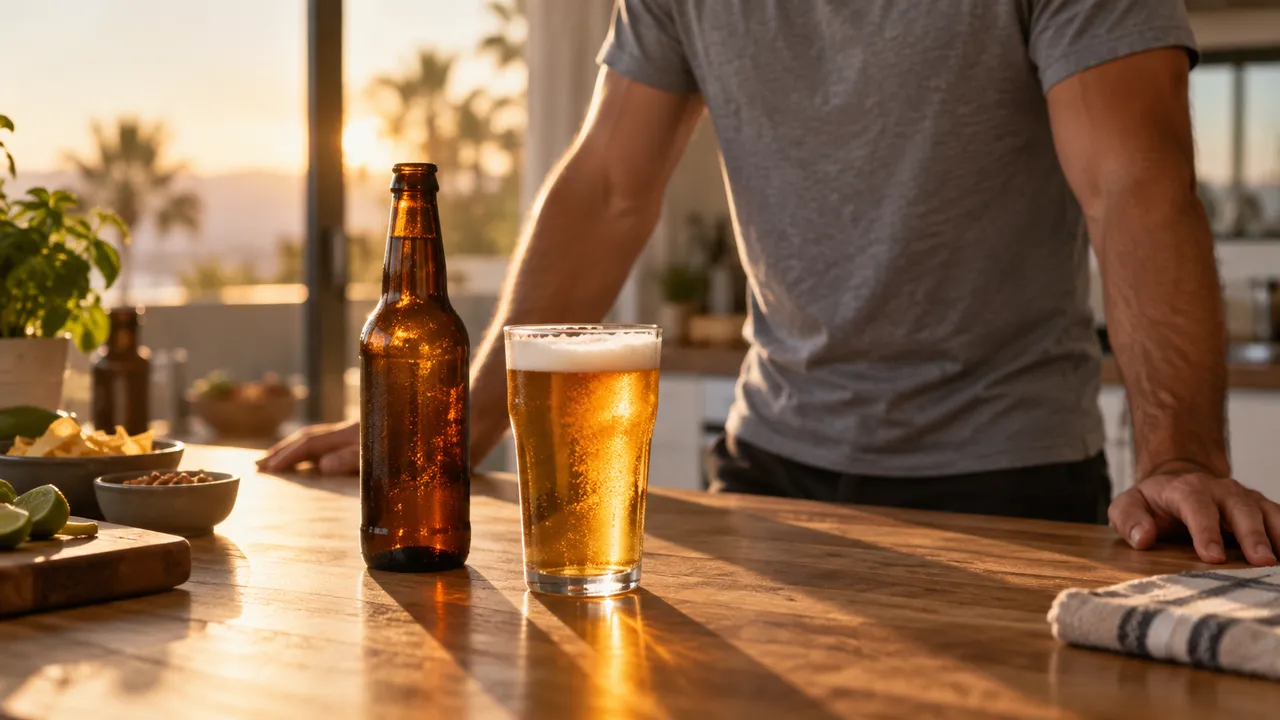
Alcohol does not turn into belly fat directly. Very little of it is converted to fat at all. The effect is indirect: drinks add calories that most people do not offset, and while the body clears alcohol it burns far less fat. Over months, that combination makes fat gain easier, and in men the gain is often measured at the waist.
How does alcohol lead to fat gain?
Pure alcohol provides 7 calories per gram, according to a 2015 review in Current Obesity Reports. In the United States a standard drink contains about 14 grams of pure alcohol, says the National Institute on Alcohol Abuse and Alcoholism (NIAAA). That is roughly 100 calories from the alcohol alone, before any sugar or carbohydrate in the drink.
The same review found that energy from alcohol appears to be additive. In short-term studies, people did not eat less to make up for the calories they drank. It cites an earlier review in which 10 of 17 studies found that people ate more food after drinking.
How many calories are in a drink?
MedlinePlus, the patient site of the National Library of Medicine, lists these typical values.
| Drink | Serving | Calories |
|---|---|---|
| Regular beer | 12 fl oz (360 mL) | 153 |
| Light beer | 12 fl oz (360 mL) | 103 |
| Red wine | 5 fl oz (150 mL) | 125 |
| White wine | 5 fl oz (150 mL) | 121 |
| 80-proof gin, rum, vodka or whiskey | 1.5 fl oz (45 mL) | 97 |
| Margarita | 4 fl oz (120 mL) | 168 |
| Pina colada | 7 fl oz (210 mL) | 380 |
MedlinePlus notes that going out for a couple of drinks can add 500 calories or more to a day. Three regular beers come to about 460 calories. Cocktails mixed with soda, juice or cream run highest.
What does alcohol do to fat burning?
The liver turns most alcohol into acetate, and the body burns that acetate in place of fat. In a 1999 study in the American Journal of Clinical Nutrition, eight healthy men drank 24 grams of alcohol, a little under two standard drinks. Less than 5% of the alcohol was converted to fat. About 77% became acetate. While that was happening, whole-body fat burning fell by 73% and the release of fatty acids from fat tissue fell by 53%.
The effect is temporary and the study was small. It does not show that two drinks make anyone fatter. It points to a mechanism: while alcohol is being cleared the body burns less fat, so fat from the food you eat with those drinks is more likely to be stored. When drinking is frequent and total calories run above what you burn, the stored fat adds up.
Does alcohol specifically add fat at the waist in men?
The link depends on the amount. A 2007 population study in the European Journal of Nutrition examined 1,491 Spanish men. Those who drank more than 30 grams of alcohol a day, a bit over two US standard drinks, had 1.8 times the odds of abdominal obesity. The result held after adjusting for smoking, education, leisure activity, total energy and diet quality. This was a one-time survey, so it shows an association, not proof of cause.
The 2015 review reached a similar conclusion across many studies. Light to moderate drinking was generally not associated with gaining body fat, while heavy drinking was more consistently related to weight gain. The authors add that current studies have important limitations and that alcohol may be a risk factor for obesity in some people, not all.
Is beer worse than wine or spirits?
The term beer belly has some support. The review cites studies linking beer intake with abdominal fat in men. It notes that beer is rich in carbohydrate and provides more energy per standard drink than wine, and that beer and spirit drinkers tend to have poorer eating habits than wine drinkers. That may explain part of the difference.
The picture is not one-sided. In one study that followed men for 8.5 years, light to moderate beer drinkers gained less at the waist than both non-drinkers and heavy drinkers. The review found no experiments that specifically tested heavy drinking or spirits. On the evidence so far, the total amount of alcohol and total calories matter more than the type of drink.
How can you drink and still lose fat?
- Count drinks as foodA drink is about 100 to 150 calories, sometimes far more. Put it in the same daily budget as your meals.
- Decide the number before you startThe waist data points at heavy intake. Fewer drinks, less often, changes the math more than switching brands.
- Choose lower-calorie drinksLight beer, wine or a spirit with a zero-calorie mixer carries roughly 100 to 125 calories. A creamy cocktail can pass 300.
- Plan the food around itPeople tend to eat more after drinking. Eat a normal meal first and decide in advance what you will order.
- Judge the week, not the nightOne evening will not change your waist. Several heavy nights every week can.
Questions people ask
Does alcohol stop fat burning?
For a few hours, largely yes. In a 1999 study of eight men, 24 grams of alcohol cut whole-body fat burning by 73% while the alcohol was being cleared. It is a short-term effect, measured in the hours after drinking.
How many calories are in a beer?
MedlinePlus lists 153 calories for a 12 fl oz regular beer and 103 for a light beer. Strong craft beers and larger pours carry more.
Will cutting out alcohol reduce belly fat?
It removes calories and lets normal fat burning continue, which helps if it puts you in a calorie deficit. It does not target the belly by itself, and results depend on your overall eating and activity.
Is wine better than beer for belly fat?
A glass of wine has slightly fewer calories than a regular beer, and studies link beer more often with abdominal fat in men. Total alcohol and total calories matter more than the type.
How much drinking is linked to a bigger waist?
In a 2007 study of Spanish men, more than 30 grams of alcohol a day, a bit over two US standard drinks, was associated with 1.8 times the odds of abdominal obesity. Reviews find little link at light intake.
Sources
- NIAAA (NIH). What Is a Standard Drink?
- MedlinePlus (National Library of Medicine). Calorie count - Alcoholic beverages, reviewed 2026
- Siler SQ et al. De novo lipogenesis, lipid kinetics, and whole-body lipid balances in humans after acute alcohol consumption. Am J Clin Nutr, 1999
- Traversy G, Chaput JP. Alcohol Consumption and Obesity: An Update. Curr Obes Rep, 2015
- Schroder H et al. Relationship of abdominal obesity with alcohol consumption at population scale. Eur J Nutr, 2007
This article is general information, not medical advice. Massage does not diagnose or treat any condition. If you have a health condition, ask your doctor whether massage is right for you.
 Fat lossCalorie Deficit for Men: What It Is and How Big It Should Be
A calorie deficit means eating fewer calories than you burn. How to estimate your needs, why 500 a day is the usual start, and why bigger is not better.
5 min read Fat lossCan You Lose Fat and Build Muscle at the Same Time?
Body recomposition is real but depends on where you start. Who manages it in studies, and the training, protein and deficit it takes.
5 min read Fat lossDo Poor Sleep and Stress Cause Belly Fat? What Studies Show
Short sleep makes people eat more and, in a small trial, added abdominal fat. The stress and cortisol link is plausible but less proven.
5 min read