A calorie deficit means taking in fewer calories from food and drink than your body burns. It is the condition for losing fat. Cleveland Clinic names about 500 calories a day as a starting point, and Harvard Health gives 500 to 1,000 a day for a loss of 1 to 2 pounds a week. Harvard Health advises men not to eat below 1,500 calories a day without medical supervision.
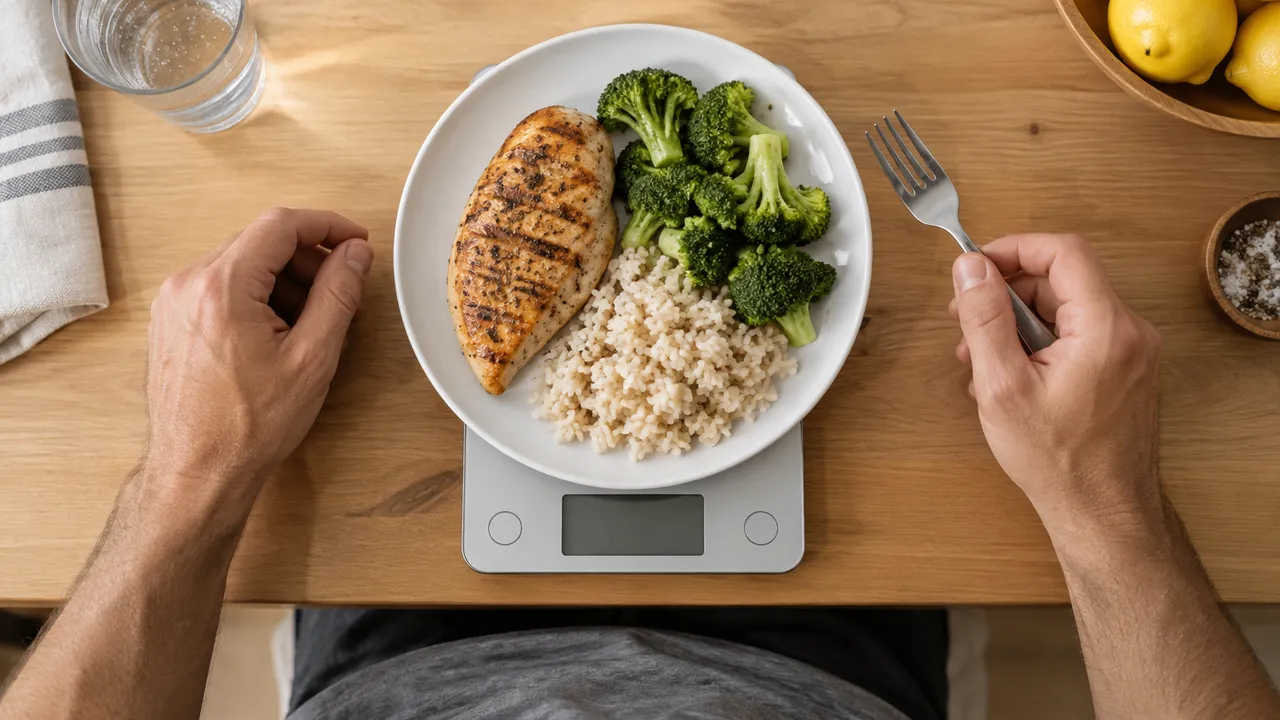
Fat loss needs one condition: the body has to use more energy than it gets from food. That gap is the calorie deficit. Everything else, from food choices to training, either creates the gap or makes it easier to keep. Here is what the term means, how to estimate your own numbers and how large the gap should be, based on Cleveland Clinic, Harvard Health, the CDC and research from the National Institutes of Health.
What is a calorie deficit?
Cleveland Clinic defines a calorie deficit as taking in fewer calories through food and drinks than your body burns during the day. When that happens, the body covers the shortfall from its reserves, mainly stored fat.
You can create the gap by eating less, by moving more, or by both. Cleveland Clinic dietitian Beth Czerwony describes a combined option: a smaller cut of 200 or 300 calories a day from food, plus more exercise to widen the gap.
How do you estimate how many calories you burn?
You need a starting number for maintenance, the calories that keep your weight stable. There are three practical ways to get one.
- Quick ruleHarvard Health suggests multiplying your current weight in pounds by 15. The result is the approximate number of calories that maintains your weight if you are moderately active, meaning at least 30 minutes of physical activity a day. For a 200 lb (91 kg) man that is about 3,000 calories.
- FormulaCleveland Clinic points to the Mifflin-St Jeor formula, which uses height, weight, sex, age and activity level. Many online calculators are built on it.
- NIH Body Weight PlannerThis free tool from the National Institute of Diabetes and Digestive and Kidney Diseases asks for your starting data, a goal weight and any planned change in activity. It returns calories to maintain your weight, to reach the goal and to stay there. It is meant for adults 18 and older, not for pregnant or breastfeeding women, and it warns that its values run too high for very sedentary people.
- Check against the scaleAny estimate is rough. NIH researchers wrote in The Lancet in 2011 that the energy needs of a person living a normal life cannot be measured with a precision better than about 5 percent, and the error is usually larger. Treat the number as a starting point and adjust it after a few weeks of real weigh-ins.
How big should a calorie deficit be?
The sources agree on a moderate range. Larger is faster on paper, and harder on the body.
| Daily deficit | Pace usually cited | Comment |
|---|---|---|
| 200 or 300 calories from food, plus more exercise | Slower | Combined option described by Cleveland Clinic |
| About 500 calories | About 1 lb (0.45 kg) a week | Starting point named by Cleveland Clinic and Harvard Health |
| About 1,000 calories | About 2 lb (0.9 kg) a week | Upper end of the range Harvard Health calls safe |
| Any deficit that puts intake under 1,500 calories a day for men | Faster | Only under the supervision of a health professional, per Harvard Health |
Take the 200 lb man again. With maintenance near 3,000 calories, a 500-calorie deficit means eating about 2,500 a day, and a 1,000-calorie deficit means about 2,000. Harvard Health sets the floor at 1,500 calories a day for men and 1,200 for women unless a health professional is supervising, because eating too little can deprive you of needed nutrients.
The CDC adds a reason to stay in this range: people who lose weight at a gradual, steady pace of about 1 to 2 pounds a week are more likely to keep it off than people who lose it faster.
Why does weight loss slow down when the deficit stays the same?
The popular rule says a pound of body weight equals about 3,500 calories, so 500 fewer calories a day should remove a pound every week without end. The figure itself is an estimate of the energy stored in the weight lost. The trouble starts when it is used as a forecast. In 2011 Kevin Hall and colleagues at the NIH showed in The Lancet that the rule treats the body's energy use as fixed. A lighter body burns less, at rest and in motion, so the same food intake produces a smaller and smaller gap.
Their model gives an example. A sedentary man of 100 kg (220 lb) who cuts 480 calories a day and holds that intake would level off near 75 kg (165 lb). He would reach half of that loss in about one year and 95 percent in about three years. The static rule would predict 22 kg (48 lb) in the first year alone, about twice what the model predicts. Their rule of thumb for an average overweight adult: each permanent change of 10 calories a day shifts body weight by about one pound in the end, with half of the change in the first year.
A slowdown after the first months is therefore expected. It does not mean the plan stopped working.
Why is a very large deficit a bad idea?
- Side effects. Cleveland Clinic lists fatigue, nausea, dehydration, constipation, headaches and irritability with a high calorie deficit.
- Nutrient gaps. Harvard Health warns that eating too few calories can deprive you of needed nutrients.
- Loss of lean tissue. The Lancet paper notes that body fat and lean tissue generally change in parallel, and that people with less body fat lose a larger share of their weight from lean tissue.
- Poor odds of keeping it off. The CDC links slower loss with better long-term results.
Protein intake and strength training also influence how much of the lost weight is muscle.
Questions people ask
Is a 500-calorie deficit enough to lose weight?
For most people, yes. Cleveland Clinic says a daily 500-calorie deficit should allow a loss of about 1 pound a week. The pace slows over time as body weight drops.
Is 3,500 calories really one pound of fat?
As a rough estimate of the energy stored in a pound of body fat, the figure is still in use. As a forecast of weight loss it overestimates. A 2011 NIH paper in The Lancet showed the rule ignores the drop in energy use as weight falls. In the paper's worked example, the model predicts about half the first-year loss the rule does.
What is the lowest number of calories a man should eat?
Harvard Health says intake should not fall below 1,500 calories a day in men, or 1,200 in women, except under the supervision of a health professional.
Does exercise count toward the deficit?
Yes. The deficit is the gap between what you eat and what you burn, so added activity widens it. One option Cleveland Clinic describes is cutting 200 or 300 calories from food and adding exercise.
Does massage create a calorie deficit?
No. A deficit comes only from eating less or moving more, and a massage does neither for you. Massage does not burn fat.
Sources
This article is general information, not medical advice. Massage does not diagnose or treat any condition. If you have a health condition, ask your doctor whether massage is right for you.
 Fat lossCan You Lose Fat and Build Muscle at the Same Time?
Body recomposition is real but depends on where you start. Who manages it in studies, and the training, protein and deficit it takes.
5 min read Fat lossDo Poor Sleep and Stress Cause Belly Fat? What Studies Show
Short sleep makes people eat more and, in a small trial, added abdominal fat. The stress and cortisol link is plausible but less proven.
5 min read Fat lossDoes Alcohol Cause Belly Fat in Men? What Studies Show
Alcohol is rarely turned into fat, but it adds calories and cuts fat burning for hours. What studies show about drinking and waist size in men.
5 min read