Yes. Controlled trials show fat loss and muscle gain can happen together. It is most likely in men who are new to lifting or carry more body fat, and smaller in trained or lean men. It takes progressive resistance training, a moderate calorie deficit and enough protein. A 2026 review suggests about 1.6 to 2.4 grams per kilogram a day.
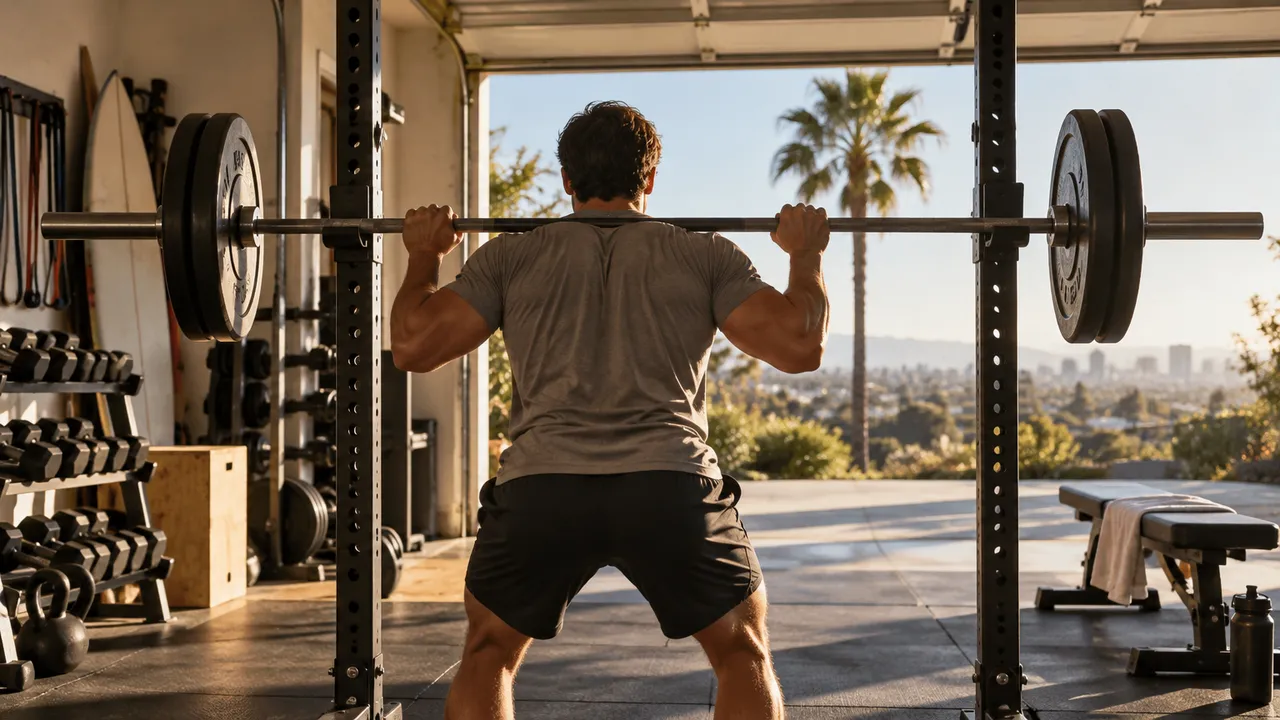
Yes, and it has been measured in controlled trials. Losing fat while gaining muscle is called body recomposition. It is most likely if you are new to lifting or carry more body fat, and it gets harder the leaner and more trained you are. The conditions are the same for everyone: progressive resistance training, enough protein and a moderate calorie deficit.
What does the research show?
A 2026 narrative review in the Journal of the International Society of Sports Nutrition looked at randomized trials and concluded that body recomposition is feasible but context-dependent. Expected changes are generally modest in trained or lean people.
A frequently cited example is a 2016 randomized trial by Longland and colleagues in the American Journal of Clinical Nutrition. Forty young men ate about 40% below their calorie needs for four weeks and trained six days a week with weights and high-intensity intervals. The group eating 2.4 grams of protein per kilogram of body weight gained 1.2 kg (2.6 lb) of lean mass and lost 4.8 kg (10.6 lb) of fat. The group eating 1.2 grams per kilogram held lean mass about level, at plus 0.1 kg, and lost 3.5 kg (7.7 lb) of fat.
The limits matter. The trial lasted four weeks, the food was provided, and the training load was far above what most men do. The authors called it a proof of principle. It shows the body can add lean mass in a deficit. It does not predict what a typical month will bring.
Who is most likely to lose fat and gain muscle together?
| Starting point | What the 2026 review reports |
|---|---|
| New to resistance training | Fat loss with lean mass gain is most prevalent in this group |
| New to training with higher body fat | The most striking recomposition |
| Resistance-trained | Less common and generally smaller in size |
| Already lean | Higher risk of losing lean mass during a calorie deficit |
| Older adults | May mainly preserve lean mass during fat loss; gains still feasible with supervised training and enough protein |
In plain terms, the further you are from your muscular potential and the more fat you carry, the more room there is to do both at once.
How big should the calorie deficit be?
Moderate. A 2022 meta-analysis in the Scandinavian Journal of Medicine and Science in Sports pooled randomized trials of resistance training during a calorie deficit. Gains in lean mass were impaired compared with training without a deficit, while strength gains were similar. Its modeling suggested that a deficit of about 500 calories a day was enough, on average, to prevent lean mass gains.
The 2026 review suggests roughly 10 to 20% below maintenance, and a loss of no more than about 0.5 to 0.7% of body weight per week for trained people. For a 90 kg (198 lb) man that is about 0.45 to 0.63 kg (1.0 to 1.4 lb) a week. It notes that losing more than 1% of body weight per week is associated with greater loss of lean mass, even in well-trained athletes.
How much protein and training does it take?
The 2026 review puts daily protein at about 1.6 to 2.4 grams per kilogram of body weight, with the higher end for people who are lean or in a deficit, split into meals of about 0.3 to 0.5 grams per kilogram. For a 90 kg (198 lb) man that is 144 to 216 grams a day. This is the range of one review, not an official standard. The 2016 joint position statement of the Academy of Nutrition and Dietetics, Dietitians of Canada and the American College of Sports Medicine gives 1.2 to 2.0 grams per kilogram a day for active people and says 2.0 grams or higher may help protect muscle during a calorie deficit. The two ranges overlap. A 2018 pooled review of 49 trials and 1,863 participants in the British Journal of Sports Medicine found that protein beyond about 1.6 grams per kilogram added no further lean mass from resistance training. The 2026 review reserves the higher intakes for periods of calorie restriction.
For training, the review points to about 10 to 20 sets per major muscle group per week, with each muscle group trained about twice a week, and loads maintained or increased over time. More volume than that did not appear to protect lean mass better.
Sleep also counts. The review cites a study in which dieters sleeping about 5.5 hours lost 60% more lean mass and 55% less fat than those sleeping 8.5 hours. That study had no resistance training, so the size of the effect may differ for lifters.
How do you set up a recomposition phase?
- Lift with progressionTrain each major muscle group about twice a week, 10 to 20 hard sets per group weekly, and add load or reps over time.
- Set a moderate deficitAim for roughly 10 to 20% below maintenance. Larger deficits speed fat loss and work against muscle gain.
- Get enough proteinThe 2026 review suggests about 1.6 to 2.4 grams per kilogram of body weight a day, spread across your meals. If you have a kidney condition, ask your doctor before raising protein.
- Protect sleepShort sleep shifted weight loss away from fat and toward lean tissue in the study the review cites.
- Measure more than weightTrack waist, training numbers and photos. The review states that relying only on scale weight is insufficient.
- Review every few weeksIf strength is rising and the waist is shrinking, stay the course. If both stall, adjust food or training.
Why is the scale not moving if it is working?
Because the two changes offset each other. Gaining a kilogram of muscle while losing a kilogram of fat leaves body weight unchanged, yet the waist gets smaller and lifts go up. The review also warns that DXA scans, bioimpedance scales and skinfolds may lack the precision to detect small changes in one person. Judge the trend over months, not a single reading.
Questions people ask
Can you build muscle in a calorie deficit?
Yes, mainly if you are new to lifting or have more body fat. A 2022 pooled review found that a deficit of about 500 calories a day was enough, on average, to prevent lean mass gains, so keep the deficit moderate.
How long does body recomposition take?
There is no fixed timeline. One four-week trial showed fast changes under extreme, supervised conditions. A 2026 review describes changes in trained or lean people as generally modest, so expect to judge progress over months.
Should I bulk and cut instead?
Men who are already lean and well trained often get little from recomposition, which is why separate muscle-gain and fat-loss phases are common in that group. Beginners and men with more body fat are the most likely to manage both at once.
How much protein do I need to lose fat and gain muscle?
A 2026 review suggests about 1.6 to 2.4 grams per kilogram of body weight a day, toward the higher end when you are lean or in a deficit. For a 90 kg (198 lb) man that is 144 to 216 grams.
Does lifting weights alone burn belly fat?
Lifting builds and protects muscle. Fat loss still depends on a calorie deficit, and you cannot choose which area loses fat first.
Sources
- Naddafha S et al. Body recomposition in adults: mechanisms, modulators, and practical algorithms for simultaneous skeletal muscle mass gain and fat mass loss. J Int Soc Sports Nutr, 2026
- Longland TM et al. Higher compared with lower dietary protein during an energy deficit combined with intense exercise promotes greater lean mass gain and fat mass loss: a randomized trial. Am J Clin Nutr, 2016
- Murphy C, Koehler K. Energy deficiency impairs resistance training gains in lean mass but not strength: a meta-analysis and meta-regression. Scand J Med Sci Sports, 2022
- Morton RW et al. A systematic review, meta-analysis and meta-regression of the effect of protein supplementation on resistance training-induced gains in muscle mass and strength in healthy adults. Br J Sports Med, 2018
- Thomas DT, Erdman KA, Burke LM. ACSM Joint Position Statement: Nutrition and Athletic Performance. Medicine and Science in Sports and Exercise, 2016
This article is general information, not medical advice. Massage does not diagnose or treat any condition. If you have a health condition, ask your doctor whether massage is right for you.
 Fat lossCalorie Deficit for Men: What It Is and How Big It Should Be
A calorie deficit means eating fewer calories than you burn. How to estimate your needs, why 500 a day is the usual start, and why bigger is not better.
5 min read Fat lossDo Poor Sleep and Stress Cause Belly Fat? What Studies Show
Short sleep makes people eat more and, in a small trial, added abdominal fat. The stress and cortisol link is plausible but less proven.
5 min read Fat lossDoes Alcohol Cause Belly Fat in Men? What Studies Show
Alcohol is rarely turned into fat, but it adds calories and cuts fat burning for hours. What studies show about drinking and waist size in men.
5 min read