There is no research-backed schedule for body sculpting massage. Trials that compared massage doses were done for knee and neck pain, where 60-minute sessions one to three times a week worked better than shorter ones. Any effect on puffiness or skin texture is temporary, so the practical guide is how long a change lasts for you and how your body recovers.
Published research does not answer this question directly. The trials that compared massage schedules head to head were done on people with knee arthritis and chronic neck pain, not on healthy men who want a tighter-looking waist. They are still useful, because they show how massage effects build up and how fast they fade once sessions stop.
Is there a research-backed schedule for body sculpting massage?
No. Body sculpting massage is a wellness service built from several techniques: manual lymphatic drainage, vibration massage and vacuum cupping. Research on these techniques in healthy people is thin. Cleveland Clinic (2024) describes lymphatic drainage massage as a treatment for lymphedema and says that if you do not have lymphedema, you may not see meaningful results.
So any fixed plan, such as a set number of sessions per week, comes from practice, not from a study. Massage also does not remove body fat. Fat stores shrink in a calorie deficit, and no massage frequency replaces that.
What do studies of massage frequency show?
Three studies compared massage doses directly. None of them measured waist size, swelling or skin texture, so read them as a guide to how massage dose behaves in general.
| Study | Who took part | Schedules compared | Main finding |
|---|---|---|---|
| Perlman and colleagues, PLoS One, 2012 (randomized trial) | 125 adults with knee osteoarthritis | 30 or 60 minutes, once or twice a week, for 8 weeks, versus usual care | The 60-minute groups improved more than usual care at 8 weeks. The benefit leveled off at 60 minutes once a week. At 24 weeks no measure differed from usual care. |
| Sherman and colleagues, Annals of Family Medicine, 2014 (randomized trial) | 228 adults with chronic neck pain | 30 minutes 2 or 3 times a week, or 60 minutes 1, 2 or 3 times a week, for 4 weeks, versus a wait list | 30-minute sessions were no better than the wait list. 60-minute sessions 2 or 3 times a week raised the chance of a meaningful improvement. |
| Rapaport and colleagues, Journal of Alternative and Complementary Medicine, 2012 (preliminary randomized study) | 53 healthy young adults, 45 of whom completed the study | 45 minutes of Swedish massage once or twice a week for 5 weeks, versus light touch | Hormone and immune markers shifted for several days to a week, and the pattern differed between weekly and twice-weekly massage. The authors asked for larger confirming studies. |
Three points come out of this. First, session length matters: in both pain trials 60 minutes did better than 30. Second, more is not always better: for knee pain the benefit stopped growing at one 60-minute session a week. Third, the effect does not last forever: in the knee trial, 16 weeks after the last session the massage groups no longer differed from usual care.
How long do the visible effects of massage last?
By the best available sources, not long. The American Academy of Dermatology reviewed a deep-massage device with a vacuum tool (sold as Endermologie) that is used for cellulite. Its summary: study results vary, and in the studies that found a visible change the results were temporary. The AAD adds that the cellulite tends to return within 1 month of stopping treatment, and that the FDA has not said the device works. Those studies were done in women.
No study has timed how long reduced puffiness lasts in healthy men after lymphatic drainage massage. The body regulates fluid all day long, so a change in puffiness after a session is best treated as temporary until research shows otherwise.
How should you decide how often to go?
With no tested schedule, the sensible approach is to treat the first few sessions as a trial and let your own results guide you.
- Name your goalIf the goal is to relax, recover from training or feel less puffy, the schedule depends on how you feel. If the goal is less body fat, the main work is food and training, and massage is an add-on.
- Check your health firstCleveland Clinic lists blood clots, deep vein thrombosis, infection, fever, heart disease, kidney failure and stroke as reasons to avoid lymphatic drainage massage. If any of these apply, talk to your doctor first.
- Track a few sessionsMeasure the same spot with a tape at the same time of day, and take photos in the same light. Write down how many days any change lasts.
- Leave room for recoveryIf an area is sore or cupping has left marks, wait until that settles before the same area is worked again, and tell your therapist.
- ReassessCleveland Clinic advises people who have several lymphatic drainage sessions without noticeable improvement to ask about other options. The same logic works here: if you cannot see or feel a benefit, more sessions are unlikely to change that.
Is once a week enough, or is more better?
The trials point in two directions. For knee pain, one 60-minute session a week gave as much benefit as two. For chronic neck pain over 4 weeks, two or three 60-minute sessions a week did better than one. These are different conditions, and neither is body contouring. No research shows that daily sessions do more for the look of the waist or flanks than weekly ones.
Questions people ask
How many sessions does it take to see results?
No study answers this for body sculpting massage. Cleveland Clinic notes that you might not see immediate results from lymphatic drainage massage and that people without lymphedema may not see meaningful results. Any early change you notice is not fat loss.
Can you get a body sculpting massage every day?
Research gives no reason to. In a 2012 randomized trial for knee pain, the benefit leveled off at one 60-minute massage a week, and no study shows daily sessions improve body contour.
Do the results last after you stop?
Expect them to fade. The American Academy of Dermatology says cellulite tends to return within 1 month of stopping vacuum massage device treatment, and in a knee pain trial the massage groups no longer differed from usual care 16 weeks after the last session.
Is a 30-minute session enough?
In the two dose trials, 60 minutes did better than 30, and for neck pain 30-minute sessions were no better than a wait list. Those trials measured pain, not body shape.
Does more massage mean more fat loss?
No. Massage does not remove body fat at any frequency. Fat loss comes from a calorie deficit, and massage can only sit alongside that.
Sources
- Perlman AI et al. Massage therapy for osteoarthritis of the knee: a randomized dose-finding trial. PLoS One, 2012
- Sherman KJ et al. Five-week outcomes from a dosing trial of therapeutic massage for chronic neck pain. Annals of Family Medicine, 2014
- Rapaport MH et al. A preliminary study of the effects of repeated massage on hypothalamic-pituitary-adrenal and immune function in healthy individuals. Journal of Alternative and Complementary Medicine, 2012
- American Academy of Dermatology: Cellulite treatments: What really works?
- Cleveland Clinic: Lymphatic Drainage Massage (2024)
This article is general information, not medical advice. Massage does not diagnose or treat any condition. If you have a health condition, ask your doctor whether massage is right for you.
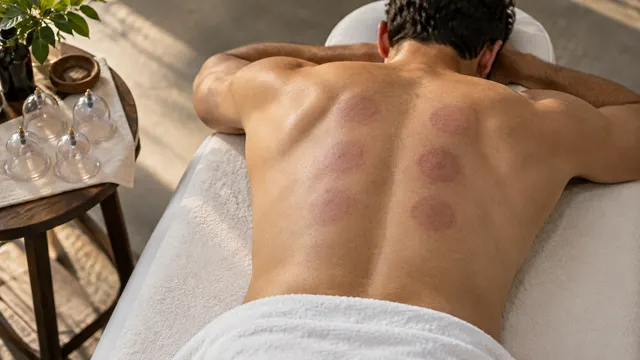 Your sessionAre Cupping Marks and Bruising Normal? How Long They Last
Why vacuum cupping leaves round marks, how long they last according to Cleveland Clinic and Harvard, who bruises more, and when to call a doctor.
5 min read Your sessionDoes Massage Help Recovery After a Workout? The Evidence
Meta-analyses show massage after exercise reduces muscle soreness and fatigue. It does not improve strength, speed or endurance. Here is the data.
5 min read Your sessionFirst Body Sculpting Massage: What to Expect Step by Step
A first body sculpting massage step by step: health questions, lymphatic drainage, vibration, cupping, how each feels, and what is normal after.
5 min read