A mobile massage therapist brings a table and supplies to your home or hotel, asks health questions, and works much as in a studio. California does not license massage therapists. The state-recognized credential is voluntary certification from the California Massage Therapy Council (CAMTC), which you can check by name or certificate number on camtc.org. Cities and counties regulate massage businesses separately.
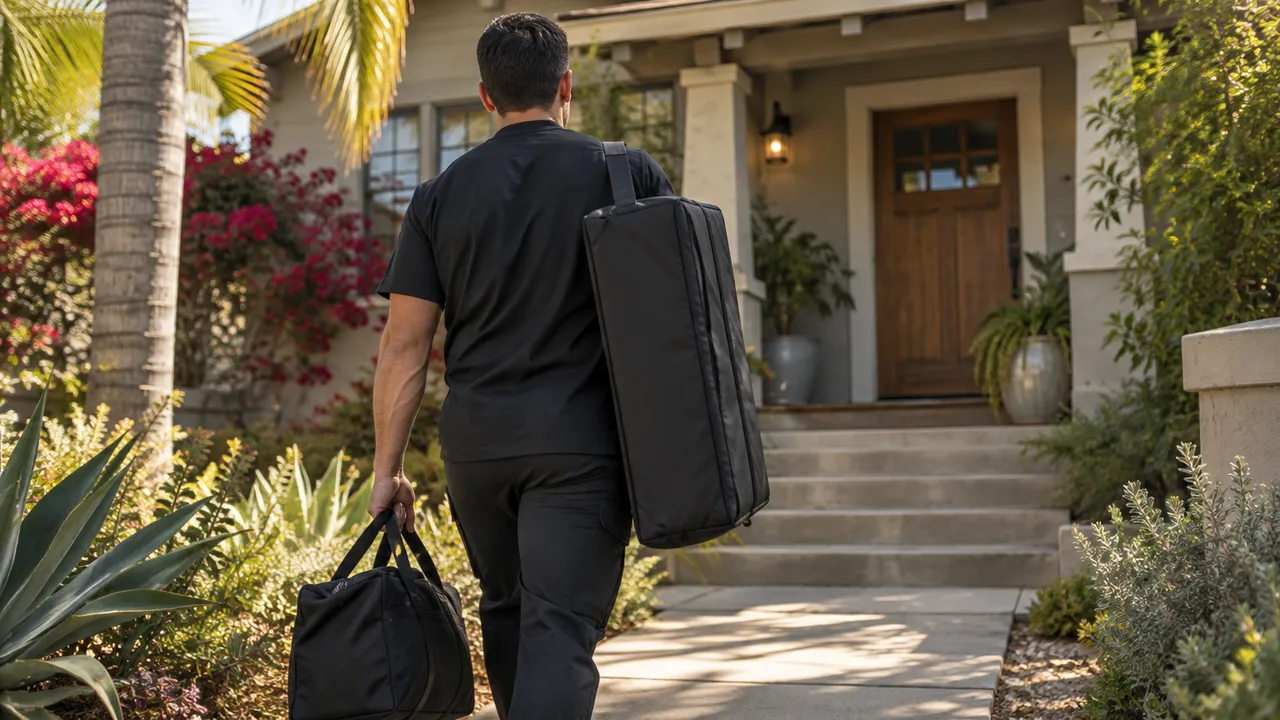
A home visit follows the same routine as a studio massage, with two differences: the therapist travels to you, and you cannot rely on a front desk to vouch for who is coming. In California you can check that yourself in about a minute. This guide covers the visit, the setup at home, and how the state's certification system works.
How does a mobile massage appointment work?
- BookingYou choose a time and give an address. Expect to share your full name and a phone number. A therapist who travels to private homes needs to know who the client is, just as you need to know who the therapist is.
- Arrival and setupThe therapist brings a folding massage table, linens and equipment, and sets up in the room you choose. Setup takes a few minutes.
- Health questionsThe American Massage Therapy Association (AMTA) says a therapist will ask preliminary questions about your overall health and goals, including medical history, medications and areas of pain.
- The sessionThe therapist steps out while you undress to your comfort level and lie under a sheet or towel. Only the area being worked on is uncovered. As general background, the AMTA says a table massage usually lasts between 30 and 90 minutes, and that you can ask for changes in pressure at any time.
- Wrap-upYou get up slowly and dress in private while the therapist waits outside the room, then packs up.
Body Sculpt is a mobile service of this kind: the massage therapist comes to your home in the Los Angeles area with a table and everything needed for the session.
What do you need at home for a mobile massage?
- A clear floor area large enough for a massage table, with room to walk around it.
- A room with a door, so you can undress and dress in private.
- A power outlet nearby if the session includes a vibration machine.
- A comfortable room temperature. You will be lying still and partly uncovered.
- A place to park, or clear instructions for gates, elevators and building entry.
- Pets and phones out of the room.
Are massage therapists licensed in California?
Not by the state. CAMTC states it plainly: 'The State of California does not license the massage profession.' Instead, the Massage Therapy Act (Business and Professions Code sections 4600 to 4621) provides for voluntary certification by CAMTC, a private nonprofit. CAMTC describes its certification as the only credential for massage professionals that is recognized by state law.
Voluntary means the state does not require it. CAMTC notes that some cities and counties do. The law protects the titles. Business and Professions Code section 4611 makes it an unfair business practice for anyone not certified by CAMTC to use the titles licensed, certified, Certified Massage Therapist (CMT) or Certified Massage Practitioner (CMP). So when a California massage service says 'licensed', the thing to check is a CAMTC certificate. CAMTC now issues new certificates only as CMT, and says there is no difference in scope of practice between the two.
According to CAMTC, a new applicant for certification must:
- Be 18 years of age or older.
- Complete at least 500 hours of massage education at a CAMTC-approved school, including at least 100 hours in subjects such as anatomy and physiology, contraindications, health and hygiene, and business and ethics.
- Submit fingerprints through Live Scan and pass a background check.
- Recertify every two years, because certification lasts two years.
How do you check a therapist's CAMTC certification?
- Ask before the appointmentAsk whether the therapist is CAMTC certified and, if so, for the full name and certificate number. CAMTC says state law requires certificate holders to give both on request and to include the certificate number in their advertising. Certification is voluntary under state law, so not every therapist holds one.
- Search on camtc.orgOpen the Verify Certification search on the CAMTC website. You can search by certificate number, last name, first name and city of work.
- Match the resultCheck that the name matches and the certificate is current.
- Look at the ID card on arrivalCAMTC says certificate holders are required to have their CAMTC ID card in their possession while they are working and to produce it if requested. The CAMTC website shows a sample certificate and card.
What is the difference between CAMTC certification and a city permit?
They cover different things. CAMTC certifies the individual. Cities and counties regulate the business.
| CAMTC certification | City or county rules | |
|---|---|---|
| What it covers | The individual massage professional | The massage business |
| Who issues it | California Massage Therapy Council, a private nonprofit named in state law | The city or county where the work takes place |
| Required? | Voluntary under state law. Some cities and counties require it. | Varies. Most California cities require a business license, and some require an outcall or mobile massage permit. |
| What it means for the client | Education and background check verified. The certificate can be looked up online. | The business is allowed to operate in that city. |
| Limits | CAMTC is not a law enforcement or government agency and does not regulate massage establishments. | Under Government Code section 51034, a city or county may not require a CAMTC certificate holder to obtain another permit or pass another background check to provide massage. |
For mobile work, CAMTC tells therapists to check each city's rules: in most cases a business license is needed in every city served, and a few cities prohibit mobile massage altogether, or only in hotels. If you are booking to a hotel, ask the front desk whether outside therapists are allowed.
How do you keep a home massage safe and private?
- If the therapist is described as certified or licensed, verify the CAMTC certificate before the visit, not after.
- Book through a business with a real website and clear terms, not an anonymous ad.
- Tell the therapist about health conditions and medications. If you have a medical condition, talk to your doctor before booking.
- Expect professional draping. The AMTA describes a full body massage as excluding private areas.
- Speak up or stop the session if anything feels wrong. You can end a session at any time.
- Keep valuables and paperwork out of the massage room. The therapist needs one room and a place to wash hands.
Questions people ask
Does California require a license for massage therapists?
No. CAMTC states that the State of California does not license the massage profession. State law provides for voluntary certification through the California Massage Therapy Council, and some cities and counties require that certification locally.
How do you verify a massage therapist in California?
Use the Verify Certification search on camtc.org. You can search by certificate number, name and city of work. Certificate holders must also carry their CAMTC ID card while working and show it if asked.
What does CMT mean?
Certified Massage Therapist. Under California law only people certified by CAMTC may use the title. New applicants need at least 500 hours of education at a CAMTC-approved school and a fingerprint background check.
Does a mobile massage therapist need a city permit?
The individual does not need a separate local massage permit if CAMTC certified, but the business usually needs a business license in each city served, and some places require an outcall or mobile massage permit, according to CAMTC.
What does the therapist bring to a home massage?
A folding massage table, linens and the equipment for the session. You provide a private room with enough floor space and, if a machine is used, a power outlet.
Can you get a mobile massage in a hotel room?
Often yes, but rules vary. CAMTC notes that a few cities prohibit mobile massage in hotels, so check the city rules and ask the hotel.
Sources
This article is general information, not medical advice. Massage does not diagnose or treat any condition. If you have a health condition, ask your doctor whether massage is right for you.
 Your sessionAre Cupping Marks and Bruising Normal? How Long They Last
Why vacuum cupping leaves round marks, how long they last according to Cleveland Clinic and Harvard, who bruises more, and when to call a doctor.
5 min read Your sessionDoes Massage Help Recovery After a Workout? The Evidence
Meta-analyses show massage after exercise reduces muscle soreness and fatigue. It does not improve strength, speed or endurance. Here is the data.
5 min read Your sessionFirst Body Sculpting Massage: What to Expect Step by Step
A first body sculpting massage step by step: health questions, lymphatic drainage, vibration, cupping, how each feels, and what is normal after.
5 min read