For most men a safe pace is about 1 to 2 pounds (0.5 to 1 kg) a week. The CDC says people who lose weight at that gradual pace are more likely to keep it off, and the NHLBI recommends losing 5 to 10 percent of starting weight over about six months. Faster loss raises the risk of muscle loss, gallstones and regain.
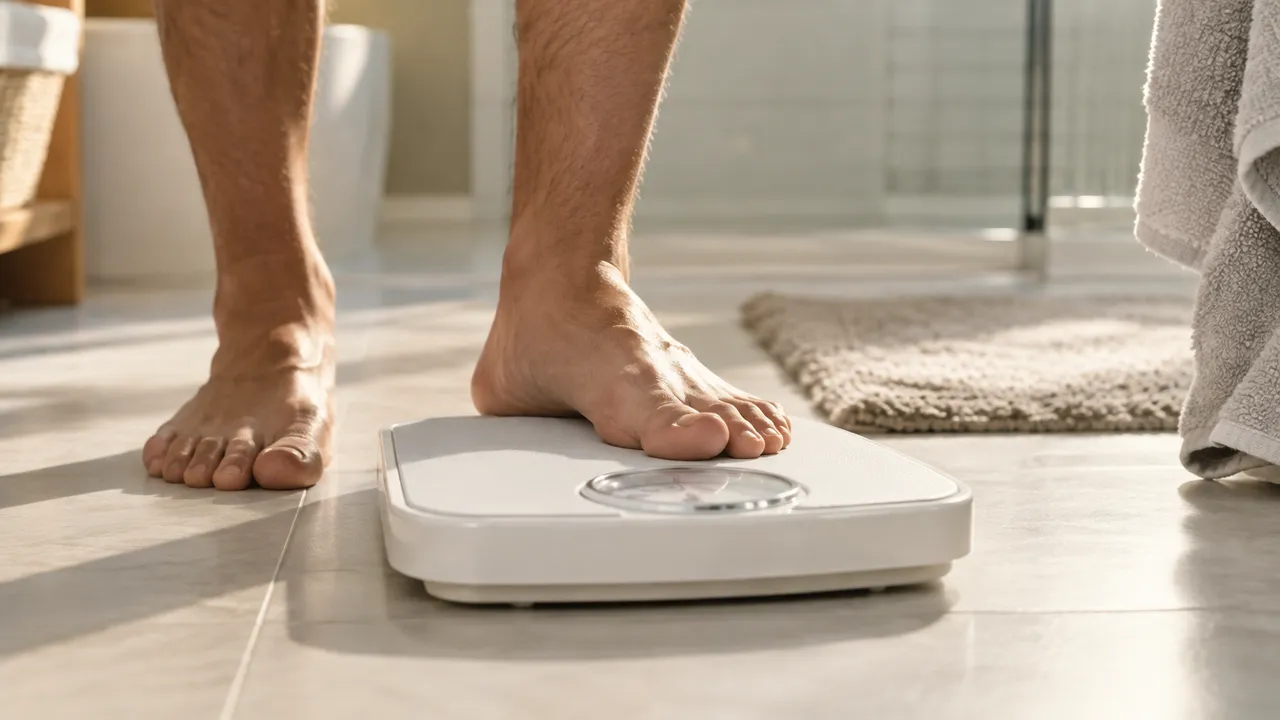
The safe speed for losing fat is slower than most diet plans promise. US health agencies give a consistent range, and research in athletes suggests that the slower end of it also protects muscle. Below are the official numbers, what they mean for a 200 lb man, and what happens when weight comes off faster.
What do the CDC and NIH recommend?
The CDC states that people who lose weight at a gradual, steady pace, about 1 to 2 pounds a week, are more likely to keep the weight off than people who lose it more quickly. It adds that even modest loss helps: a 5 percent reduction, which is 10 pounds for a 200 lb person, can improve blood pressure, cholesterol and blood sugar levels.
The National Heart, Lung, and Blood Institute (NHLBI), part of the NIH, frames the goal over a longer period. Health professionals recommend losing 5 to 10 percent of your initial weight over the course of about six months, and a loss of 3 to 5 percent already brings benefits. For a man who weighs 200 lb (91 kg), 5 to 10 percent is 10 to 20 lb. Spread over 26 weeks, that works out to roughly 0.4 to 0.8 lb a week, which is below the 1 to 2 lb range.
MedlinePlus, the patient information service of the National Library of Medicine, draws the upper line: losing more than 1 or 2 pounds a week is not safe for most people.
What counts as losing weight too fast?
MedlinePlus defines a rapid weight loss diet as one on which you lose more than 2 pounds (1 kg) a week over several weeks. The extreme form is the very low-calorie diet, which may supply as few as 800 calories a day and can produce a loss of up to 3 to 5 pounds (1.5 to 2 kg) a week. According to MedlinePlus, such a diet is only recommended for adults who have obesity and need to lose weight for health reasons, and only with the help of a healthcare provider.
| Pace | For a 200 lb (91 kg) man | What the sources say |
|---|---|---|
| 5 to 10 percent of body weight in 6 months | 10 to 20 lb in total, about 0.4 to 0.8 lb a week | Initial goal recommended by the NHLBI |
| 1 to 2 lb (0.5 to 1 kg) a week | 0.5 to 1 percent of body weight a week | CDC: gradual, steady pace, more likely to be kept off |
| More than 2 lb (1 kg) a week for several weeks | More than 1 percent of body weight a week | MedlinePlus: rapid weight loss, not safe for most people |
| 3 to 5 lb a week | 1.5 to 2.5 percent of body weight a week | Very low-calorie diets, medical supervision only |
What are the risks of losing weight too quickly?
MedlinePlus lists what rapid weight loss can cost.
- Loss of muscle, water and bone density, not just fat
- Gallstones
- Gout
- Fatigue
- Constipation, diarrhea and nausea
- Fast regain: people who lose weight quickly are also more likely to regain it quickly
For gallstones the mechanism is known. The National Institute of Diabetes and Digestive and Kidney Diseases (NIDDK) explains that when you lose weight quickly, the liver releases extra cholesterol into the bile, and fast weight loss can also keep the gallbladder from emptying properly. Repeated cycles of losing and regaining weight may also lead to gallstones. The more weight you lose and regain in a cycle, the greater the chance of gallstones. The NIDDK advice is to avoid crash diets and to lose weight at a slower pace.
Does losing weight more slowly protect muscle?
One randomized trial tested this directly. In 2011, Ina Garthe and colleagues reported in the International Journal of Sport Nutrition and Exercise Metabolism that they had assigned 24 elite athletes to lose weight at a planned 0.7 percent or 1.4 percent of body weight per week. Both groups ate less and kept doing four resistance training sessions a week, and both lost about 5.5 percent of body weight. The actual weekly rates achieved were 0.7 and 1.0 percent.
The results differed in what was lost. The slow group reduced fat mass by 31 percent and increased lean body mass by 2.1 percent. The fast group reduced fat mass by 21 percent, and its lean mass did not change. The authors concluded that athletes who want to gain lean mass and strength while losing weight should aim for about 0.7 percent of body weight a week. For a 200 lb man that is 1.4 lb a week. The 2016 joint position statement of the Academy of Nutrition and Dietetics, Dietitians of Canada and the American College of Sports Medicine cites this trial when it says that fat-free mass and performance may be better preserved in athletes who keep weekly weight loss under 1 percent.
The limits of the study matter. The participants were young, highly trained athletes, there were only 24 of them, and all were lifting four times a week. The finding supports the lower half of the 1 to 2 lb range for men who train. It does not prove the same numbers for everyone.
How do you set a pace you can keep?
- Choose a target inside the rangeAbout 1 lb a week is a reasonable start for most men. If you lift weights and want to keep muscle, stay near the lower end, as the athlete trial suggests.
- Set a time frame you can meetThe CDC lists setting specific goals you can reach in a reasonable time among its steps for losing weight. Ten to 20 lb in six months fits the NHLBI goal.
- Monitor your progressThe CDC also advises tracking where you are and checking progress regularly. Judge the trend over several weeks, not single days.
- Keep strength training in the planIn the 2011 trial, every athlete continued resistance training during the diet, and lean mass was held or increased.
- Get medical supervision for anything fasterDiets that produce more than 2 lb a week are meant for specific medical situations and need a healthcare provider.
Questions people ask
Is losing 2 pounds a week safe?
It is the upper end of the range the CDC describes as gradual and steady. MedlinePlus says losing more than 1 or 2 pounds a week is not safe for most people.
How much fat can I lose in a month?
At 1 to 2 pounds a week, about 4 to 8 pounds of body weight a month. The NHLBI goal of 5 to 10 percent in six months is slower: about 2 to 3 pounds a month for a 200 lb man.
Why does fast weight loss cause gallstones?
According to the NIDDK, when you lose weight quickly the liver releases extra cholesterol into the bile, and the gallbladder may not empty properly. Losing and regaining weight repeatedly may also lead to gallstones.
Do very low-calorie diets work?
They produce fast loss, 3 to 5 pounds a week according to MedlinePlus, but they are recommended only for adults with obesity who need to lose weight for health reasons, under a provider's care. People who lose quickly also tend to regain quickly.
Can massage speed up fat loss?
No. Massage does not burn fat, so it cannot raise the rate of fat loss. The pace is set by the calorie deficit.
Sources
- CDC. Steps for Losing Weight, 2025
- NHLBI (NIH). Aim for a Healthy Weight
- MedlinePlus (National Library of Medicine). Diet for rapid weight loss, reviewed 2026
- NIDDK (NIH). Dieting and Gallstones
- Thomas DT, Erdman KA, Burke LM. ACSM Joint Position Statement: Nutrition and Athletic Performance. Medicine and Science in Sports and Exercise, 2016 (cites Garthe et al., International Journal of Sport Nutrition and Exercise Metabolism, 2011)
This article is general information, not medical advice. Massage does not diagnose or treat any condition. If you have a health condition, ask your doctor whether massage is right for you.
 Fat lossCalorie Deficit for Men: What It Is and How Big It Should Be
A calorie deficit means eating fewer calories than you burn. How to estimate your needs, why 500 a day is the usual start, and why bigger is not better.
5 min read Fat lossCan You Lose Fat and Build Muscle at the Same Time?
Body recomposition is real but depends on where you start. Who manages it in studies, and the training, protein and deficit it takes.
5 min read Fat lossDo Poor Sleep and Stress Cause Belly Fat? What Studies Show
Short sleep makes people eat more and, in a small trial, added abdominal fat. The stress and cortisol link is plausible but less proven.
5 min read