Fat loss usually stalls because the calorie deficit has quietly closed. A lighter body burns about 20 to 30 fewer calories a day per kilogram lost, appetite rises by about 100 calories a day per kilogram, and people underestimate what they eat. Research points to rising intake, more than a slow metabolism, as the main cause.

A plateau means the calorie deficit that was driving fat loss is gone. Nothing is broken. Your body now burns a little less, your appetite pushes harder, and your tracking has probably loosened. The result is that intake and output meet again at a lower weight.
Is a weight loss plateau normal?
Yes. A 2018 review in Medical Clinics of North America by Kevin Hall of the National Institutes of Health and Scott Kahan describes the typical pattern: early rapid weight loss followed by a plateau. In their model, the plateau arrives within the first year of a diet. In the example they work through, it comes at about six months.
A 2011 modeling paper in The Lancet explains why patience matters. Body weight responds slowly to a change in calorie intake, with half of the eventual change taking about a year. A flat week or two inside that long curve can be water hiding fat loss on the scale, not a true stall.
Has my metabolism slowed down?
A little, and it is expected. The 2018 review estimates that for each kilogram (2.2 lb) of weight lost, the body burns about 20 to 30 fewer calories a day. A man who has lost 10 kg (22 lb) burns roughly 200 to 300 fewer calories a day than when he started. The meal plan that produced a deficit at the start may now be close to maintenance.
Appetite moves more. The same review estimates that appetite rises by about 100 calories a day for each kilogram lost. The authors conclude that appetite changes likely play a more important role than slowing metabolism in explaining the plateau. In their worked example of a 90 kg (198 lb) woman, the body's calorie burn had fallen by less than 200 calories a day at the plateau, while intake had climbed back by 600 to 700 calories a day from its reduced starting level.
Could I be eating more than I think?
It is common, and it does not require carelessness. Hall and Kahan note that daily intake naturally varies by 20 to 30%, so a slow upward drift in portions is easy to miss.
A classic 1992 study in the New England Journal of Medicine tested this directly. Ten adults with obesity reported eating under 1,200 calories a day without losing weight. Measured over 14 days, their energy expenditure was within 5% of predicted values. They had underreported food intake by an average of 47% and overreported physical activity by 51%. The group was small and had a long history of failed diets, so the size of the error will not apply to everyone. The direction of the error is the lesson.
The NIH Body Weight Planner makes the same point in its instructions: people often underestimate how much they eat.
What causes a plateau, and what answers each cause?
| Cause | What is happening | What to do |
|---|---|---|
| Water masking fat loss | Salt, carbohydrate or a hard training week holds water for days | Compare weekly averages and waist over 3 to 4 weeks before deciding |
| Smaller body | About 20 to 30 fewer calories burned per day for each kilogram lost | Recalculate calorie needs at your current weight |
| Appetite drift | Portions, snacks and drinks creep up without notice | Weigh and log food for 1 to 2 weeks |
| Tracking errors | Oils, sauces, weekend meals and alcohol are missed | Log everything, including drinks and bites |
| Less movement | Workouts counted generously, fewer daily steps | Track steps or minutes, not impressions |
What should you do when fat loss stalls?
- Confirm it is realUse the same scale and time of day. Compare weekly averages and your waist measurement across three to four weeks. One flat week proves nothing.
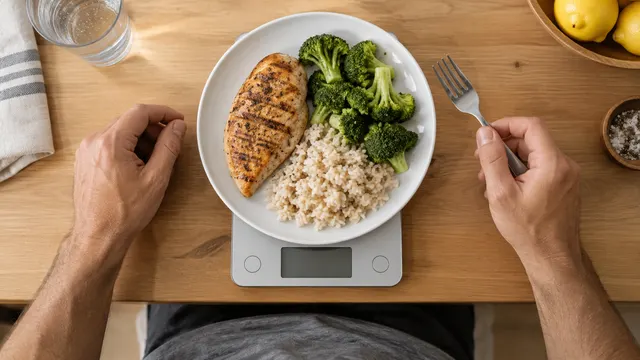
- Audit intake for two weeksWeigh food on a kitchen scale and log all of it. The CDC calls writing down what you eat the single best predictor of weight loss success.
- Recalculate for your current weightThe free NIH Body Weight Planner estimates the calories needed to reach a goal weight and to hold it afterward.
- Adjust one thingTrim a small, specific amount of food or add a fixed amount of activity. Then hold it for a few weeks before judging.
- Keep strength trainingIt helps you hold on to muscle while weight comes down.
- Decide whether to keep cuttingA plateau at a healthy weight can be a reasonable place to stop. Holding a lower weight takes ongoing effort of its own.
Hall and Kahan list the habits seen in people who keep weight off: frequent self-monitoring and self-weighing, a reduced calorie intake, more physical activity, regular breakfast and more meals prepared at home.
Questions people ask
How long does a weight loss plateau last?
It lasts until the deficit is restored. In modeling by NIH researcher Kevin Hall, weight loss typically stalls within the first year, at about six months in their worked example, as intake drifts back toward what the body now burns.
Is my metabolism damaged after dieting?
The research described here does not point to damage. A 2018 review estimates the drop at about 20 to 30 calories a day per kilogram lost. Its authors conclude that appetite changes likely play a more important role in the plateau than slowing metabolism.
Should I eat less or exercise more to break a plateau?
Either can restore the deficit. First check your tracking, since underreporting is common. Then make one small change and hold it for a few weeks.
Can a plateau be water retention?
Yes, for a week or two. Water from salt, carbohydrate or hard training can hide fat loss on the scale. Compare weekly averages and waist measurements over three to four weeks.
Can massage break a fat loss plateau?
No. Massage does not change the balance between calories eaten and calories burned. It can shift fluid for a short time, which is not fat loss.
Sources
- Hall KD, Kahan S. Maintenance of Lost Weight and Long-Term Management of Obesity. Med Clin North Am, 2018
- Lichtman SW et al. Discrepancy between self-reported and actual caloric intake and exercise in obese subjects. N Engl J Med, 1992
- Hall KD et al. Quantification of the effect of energy imbalance on bodyweight. The Lancet, 2011
- NIDDK (NIH). Body Weight Planner
- CDC. Diabetes: Healthy Weight
This article is general information, not medical advice. Massage does not diagnose or treat any condition. If you have a health condition, ask your doctor whether massage is right for you.
 Fat lossCalorie Deficit for Men: What It Is and How Big It Should Be
A calorie deficit means eating fewer calories than you burn. How to estimate your needs, why 500 a day is the usual start, and why bigger is not better.
5 min read Fat lossCan You Lose Fat and Build Muscle at the Same Time?
Body recomposition is real but depends on where you start. Who manages it in studies, and the training, protein and deficit it takes.
5 min read Fat lossDo Poor Sleep and Stress Cause Belly Fat? What Studies Show
Short sleep makes people eat more and, in a small trial, added abdominal fat. The stress and cortisol link is plausible but less proven.
5 min read